- The Ladakh marathon, one of the popular high-altitude marathons in the world, is reducing single-use plastics and water consumption.
- While some athletes find it challenging to refill water at aid stations or use dry toilets, owing to time constraints in the race, others come for the new types of challenges and rewards that these high-altitude marathons offer that the urban ones don’t.
- Given the popularity and rise of the marathon culture, consumption patterns and waste management need to be prioritised, say experts.
“You run your own race in the mountains and you’re not bigger than the ecosystem in any manner,” said Anmol Lonia, 33, a runner from Bengaluru who recently participated in the 42-kilometre race in the Ladakh Marathon.
The Ladakh Marathon, one of the most popular high-altitude marathons in the world, has six races ranging from five kilometres to 122 km where athletes run at an altitude of 3,170 to 5,374 metres (10,400 to 17,631 feet). It takes place every year from early to mid-September.
Running in Ladakh is no easy feat. “You’re running on 50% less oxygen and so the challenges are unimaginable,” explained Chewang Motup, co-founder of Rimo Expeditions, which organises the marathon. But organising a marathon there successfully for 12 years is a laborious task too.
Ladakh is a high-altitude, cold desert that has been susceptible to the effects of climate change over recent years. A 2024 study published in the Journal of Water and Climate Change revealed that rising temperatures, high variability of precipitation, and changes in rainfall patterns have reduced the groundwater reserves in the region.
The organisers share that sustainability is one of the core ethos of the event. “We give equal importance to running and the environment, and that’s the only way forward for a place like Ladakh. We don’t have a choice,” said Motup.

Steps to sustainability
One of the steps that the organisers have taken this year to reduce water consumption in this marathon, is to have dry toilets along the marathon route. They note that these toilets do not require water for flushing, compost human-water and are hygienic.
Toilets are a crucial component in ultraruns (runs longer than 42 km) as athletes spend hours on the road. Sugandha Singhal, 36, an ultra-runner from Gurgaon, who participated in the 72-km race called the Khardung La Challenge said, “I didn’t see the dry toilets in the initial part of the race. This was quite tricky because it was cold, which meant I needed to use the facilities a lot more.” She said that she carried biodegradable wet wipes and discarded them at the location, but was able to spot the dry toilets only in the last 30 km of the race.
Speaking about the switch to dry toilets, Bhanu Prabha, secretary of Youth Service and Sports of Ladakh said, “After October, the water freezes. Our toilets won’t have running water. This (introduction of dry toilets) helps people appreciate the struggles we have in our daily lives.”
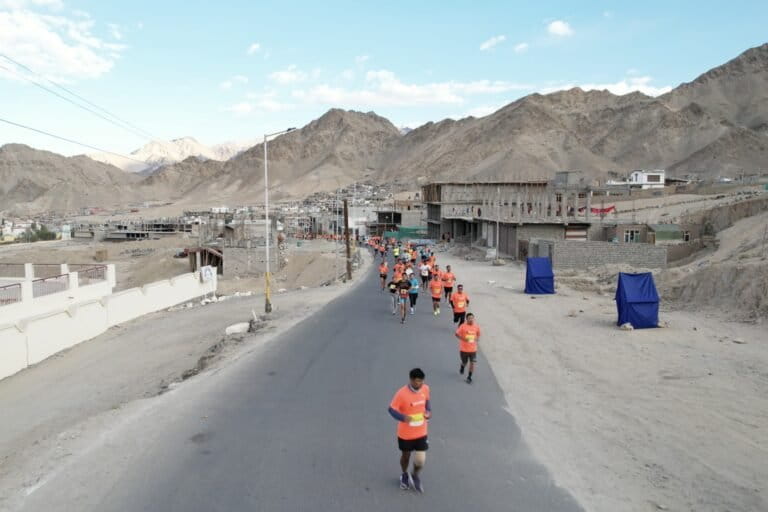
From the inception of the Ladakh Marathon in 2012, when about 1,500 runners participated, it has grown increasingly popular over the years, with its latest edition in 2025 garnering nearly 6,600 participants. “When we started in 2012 there were no local people who participated,” said Motup. “Today, 60% of the runners are from outside Ladakh while 40% are local residents. To boost local talent, the Ladakh Marathon waives a registration fee for students. Instead, they must contribute a minimum of 10 PET bottles.”
“We’ve now collected enough bottles to make T-shirts for the organising team next year. We’re still figuring out a way around high transportation costs,” added Motup.
Stanzin Yangdol, 41, a physical education teacher at Ladakh Public School said, “Some students brought plastics from home but mostly they collected trash from behind the school, an area which was littered with plastic.” She added that this activity allowed her students to connect to their surroundings and understand the impact of the work they are doing. Stanzin Chosol, 15, who has participated in 11km races twice in a row said, “In major tourist spots, I see tourists not throwing waste in bins. I felt really bad at that time. But the people of Ladakh know the value of their land.”


Understanding the race environment
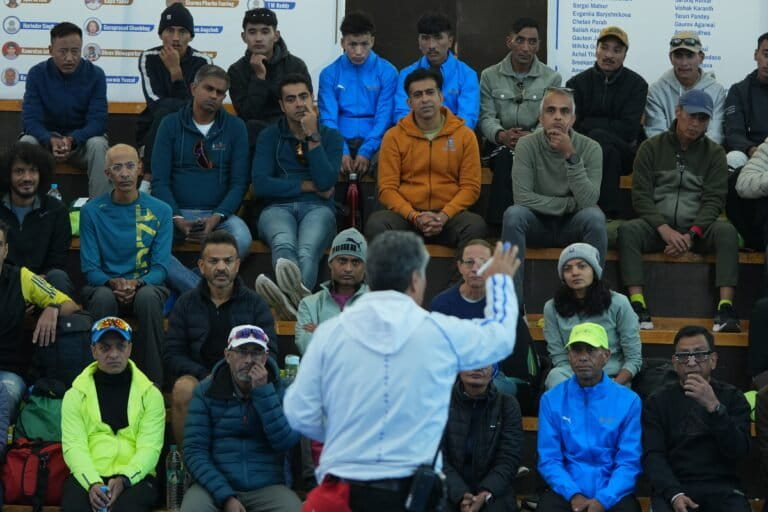
The organisers of Ladakh Marathon recommend the athletes to reach Ladakh a week or ten days before race day to acclimatise to the altitude and encourage them to choose homestays to boost the local economy and reduce the waste they generate because Leh, a capital city of Ladakh, is undergoing a massive waste management problem.
“You get to experience the culture and eat like a local. So, the respect for the route that you’re running kicks in and you tend to have to sort of replicate the race environment,” Lonia commented.
September marks the last few weeks of peak season to visit and tour Ladakh and with the overlap of the athletes and their families staying at Leh around the same time, it adds pressure on the already ecologically-fragile region. Although a dip from the previous years of 2022-2023, which saw over 5,20,000 annual visitors, Ladakh witnessed over 3,50,000 tourists in 2024.
“The most challenging part of these events is how do we encourage people to actually think about their behaviours and not only the people that are taking part, but the people that are spectating and going to be impacted by those events,” shared Seth Kirby, a senior lecturer in Sport and Leisure Management at Nottingham Trent University in the U.K.
Tackling plastic waste in marathons
Since its eighth edition in 2019, the Ladakh Marathon has slowly phased out single-use plastics. The event uses biodegradable glasses made from rice husk or sugarcane waste for water and electrolyte juices. Aid stations are equipped with mostly natural foods and water in reusable containers and cups, respectively. Participants are provided with packaged protein bars and energy gel packs ahead of the race, but are instructed to dispose of them in designated bins at these stations.
Ultrarunners who pass through the mountains are encouraged to carry their own hydration packs and refill them. But some runners find this challenging. “When you’re running an ultra, there’s thousands of things going on in your head. If I was looking at it from a timing aspect, stopping at every aid station might not help,” said Ayush Krishnan, 22, an ultrarunner from Dubai Creek Striders, who completed his full marathon last year and returned to participate in the Khardung La Challenge (72km).
Motup responded, “If you’re stopping at every station for half a minute and you’re stopping 10 times along the route, you’ll be losing time. Nobody expects their personal best here. But many runners often return for the other challenges that this marathon offers.”
“For the lack of a water bottle, you get the views. What would beat that?” continued Anand Kadkol, 49, from Mumbai participating in the full marathon (42km) “It’s not like you need to carry your water bottles all the time. They have aid stations every five kilometres. All you need to do is learn how to fuel yourself better.”
Highlighting the unique experience of running at Ladakh, many athletes who spoke to Mongabay India commented on the differences in metropolitan versus trail-based runs when it comes to upholding sustainable practices. “I did the Ooty Ultra (in Tamil Nadu) earlier this year. They were extremely sensitive because it’s ecologically very fragile. I see the same thing here. But I find that marathons which happen in metros are not so environmentally-sensitive,” said Kadkol.

“Usually, you can see thousands of bottles with water still left in them, gel packs, food wrappers and more along the race route in cities,” said Lonia whose focus on protecting the environment grew after she participated in the Kauveri Trail Marathon last year. “I was ignorant until then but quickly learned that it’s not that hard. You just have to put your waste in your pocket. It’s not going to weigh anything.”
Singhal said, “I’ve twisted my ankle once by slipping on a plastic bottle. It almost happened another time. That’s when I decided maybe these city marathons aren’t for me.”
Reeth Abraham, Director of NEB Sports Entertainment Private Limited, a Bengaluru-based sports management organisation said, “We use plastic cups that are washed and reused at our events. But we also use single-use plastic bottles for fast runners as they cannot stop.” She added that cities have better access to dispose of the waste when compared to remote runs where it’s difficult to identify the waste. “It isn’t just the responsibility of the organisers but also the runners.”
Given that the marathon culture is booming across the world, waste management needs to be an integral practice going forward, Kirby emphasised. “There’s a change in attitude in people that take part in marathons. In the past, it was about competition whereas now people are using these events to connect with their friends, their family with other social runners.”
“People having an understanding of what action they need to do, how they actually compete in these events and how that’s communicated to that final runner is really a critical part of the process,” he added.
However, Krishnan said that he doesn’t see single-use plastic items being phased out anytime. He compared his experience of participating in the Comrades Marathon (88 km), which garners thousands of participants and relies on plastic water sachets, as opposed to the trail-based marathons like the one at Ladakh which pulls in a maximum of 400 runners across two ultras.
But it isn’t just about the number of participants for Motup and his team; it’s about the message. “Ladakh marathon doesn’t make large numbers. We’re saying that if you agree with what we believe in, then you can come,” he said.
Read more: India set to participate in the World Cup for trash collection
Editor’s note: The story was updated on November 4, 2025 to correct a factual error on PET bottles.
Banner image: Sugandha Singhal, a 36-year-old ultra-runner from Gurgaon participates in the 72-km race called the Khardung La Challenge. Image courtesy of Sugandha Singhal.
Credits