
- After the first rains during the monsoons, in the Indian subcontinent, it’s breeding season for the Asian common toad.
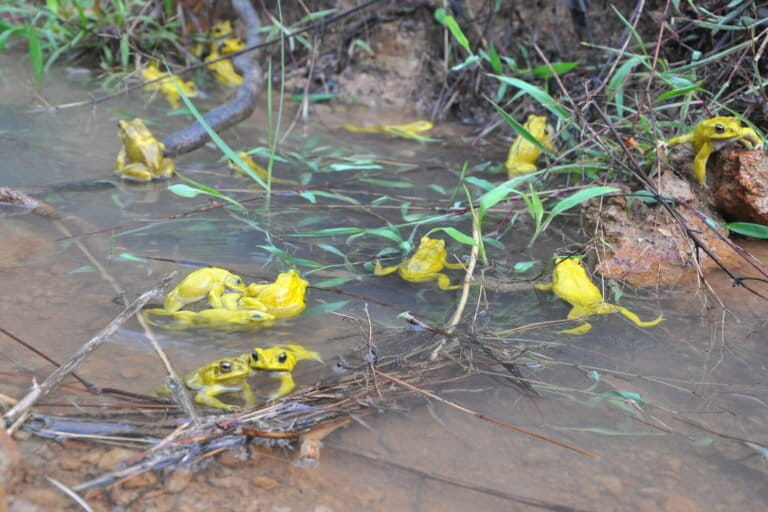
- Males and females gather in large numbers at temporary pools for explosive breeding events. Amid the rush, males rapidly shift their skin colour from dull brown to bright yellow.
- The colour transformation lasts just two days. Experiments show that the bright yellow helps males stand out amid brown females, reducing confusion and allowing faster mate recognition.
- Once breeding ends, males fade back to brown, blending into dry leaf litter to avoid predators.
When the first monsoon rains hit the Indian subcontinent, temporary rain pools transform into a stage for the Asian common toad to meet and breed. Within hours, hundreds of toads converge to breeding sites and form “explosive breeding aggregations”, where males compete with each other and scramble for females. These toads are usually a dull brown. For just the breeding period, males decide to put up bright neon signs: they turn golden yellow. Scientists call this “dynamic sexual dichromatism” — when one sex changes colour, temporarily, to signal readiness to mate.
A group of researchers decided to decode this behaviour from a toad’s perspective.
To find out how well the toads themselves recognise these colour signals, researchers Susanne Stückler and Doris Preininger teamed up with K.V. Gururaja and Priti Hebbar in the foothills of the Western Ghats in Karnataka. Armed with a spectrometer, they recorded the skin colours of toads gathered at a rock pool: males in amplexus, a mating position, were yellow to the human eye; non-mated males were both yellow and brown; and females were all brown in colour. The data were then fed into a computer model that simulated toad vision, revealing how distinctly the yellow of breeding males would stand out to other toads. They found that the toad vision simulator could easily detect the contrast between yellow males and the brown females.

To make the experiment more lifelike, the researchers created realistic 3D models of toads. Using a preserved Asian common toad specimen (Duttaphrynus melanostictus) from the Natural History Museum Vienna, they made a resin cast and painted it to match the colours measured by the spectrometer: brown for females and yellow for breeding males.
“We presented a brown model resembling a female and a yellow model mimicking a breeding competitor to a group of male Asian common toads at the explosive breeding aggregation,” the authors write. The males showed far more physical contact (nudging, pushing, and attempts for amplexus) with the brown models than with the yellow ones, showing clearly that males can tell the difference.
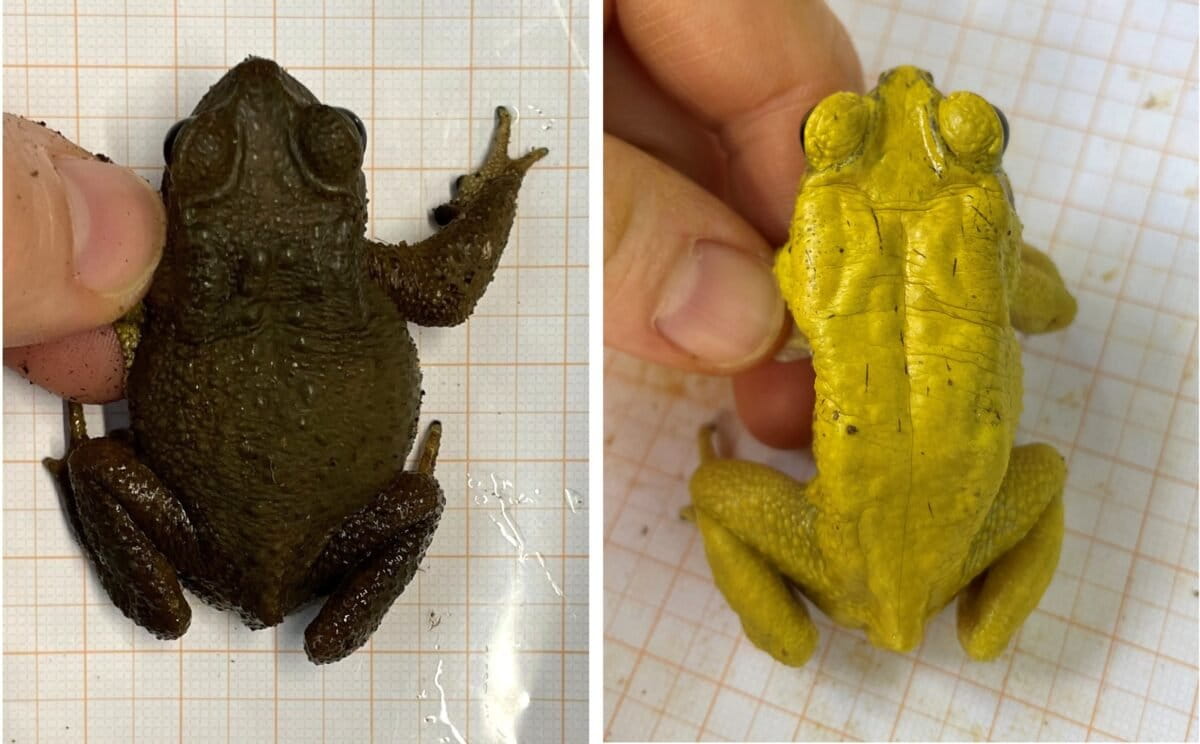
“Males amplect (grasp a mating partner) everything that is brown, even a beetle nut,” says Preininger.
Sometimes, multiple males try to waylay a female on her way to lay her eggs. They form “mating balls”. “There is so much going on, we won’t know where to look,” says Guru.
“We’ve seen this phenomenon only in populations from the Indian subcontinent and nearby regions like Bangladesh,” the researchers say. “Elsewhere in Southeast Asia, conditions are too tropical — there’s no real dry season — so the trigger for this kind of colour change might not exist. It’s likely tied to the sharp seasonal shifts of the monsoon.”

It’s all this stress
Toads changing colour is not genetically determined, says Gururaja. “The colour change is triggered by environmental cues.”
A previous study by Stückler and Preininger shows that the colour shift is caused by stress hormones such as epinephrine and norepinephrine, which are used in an animal’s classic “flight or fight” response. In fact, laboratory experiments showed that applying the hormones artificially can make a male toad turn yellow within minutes.
So essentially, males gather at a breeding site, figure out its breeding season and turn yellow. Once congregated and yellow, males start croaking. The chorus attracts females to the site. “When all males croak together, they attract more females, and they increase chances of mating success,” says Gururaja.

Interestingly, the colour seems to be purely a signboard saying “I am a male” and not a badge of fitness. “We compared size, weight, and body condition,” the researchers note. “Yellow males weren’t necessarily stronger or bigger. The colour just tells you it’s a male — nothing more, nothing less. But how these hormones maintain that yellow hue for a day or two is something we still don’t fully understand.”
Pool party
Explosive breeding is as intense as it sounds. “At the time of explosive breeding, any waterbodies that form (like plantation trenches) are all of a sudden filled with toads that mate,” say the researchers. The toads leave in two days. “A day after the event you can only see the egg strings in the water. About one week later, the tadpoles will hatch and disperse.”
“Suddenly, our field visits are full of pools filling up with toads! Almost all males are yellow, and the females remain dull brown,” says Gururaja.

But what draws the toads to these temporary ponds in the first place? The researchers think it’s both instinct and experience. “They likely return to the same water bodies from previous years,” they say. “Heavy rain triggers them, and the chorus of calls draws in females from the surrounding areas.”
Once the eggs are laid, the frenzy ends as suddenly as it began. The females leave quickly to escape more male attention, while males disperse away into the nearby foliage, a dull brown to blend into their surroundings and stay safe from predators.
This short-term makeover evolved as a smart strategy — a way to attract mates quickly, avoid same-sex confusion, and stay hidden the rest of the year. The bright yellow look may have started as a side effect of stress hormones released during the excitement of the monsoon. But over time, it became a powerful visual signal that helps the species thrive in a tight window of opportunity.

The risk of drying out
The Asiatic common toad is found almost everywhere in the Indian subcontinent, and is not threatened — yet. But, “the toads only breed once a year and that can be a concern,” says Gururaja. “For example, if there’s an unusual cyclonic activity before the monsoon, the explosive breeding will be triggered and the toads will spawn. However, one dry spell can desiccate the embryos and the entire population can be decimated,” he said. “And it’s not like the breeding behaviour will be triggered by the next wet spell.”
Read more: Climate change affects mating in yaks; breeding season shifts
Banner image: A mating pair of Asian common toads. Image by Susanne Stückler and Doris Preininger.