- A rare, stable ten-member Indian wolf pack was recorded in Madhaiganj, highlighting the conservation importance of eastern India’s fragmented, human-dominated habitats.
- With only around 3,000 wolves remaining across the country, each stable pack becomes extremely important, writes the author of this commentary.
- There need to be region-specific conservation measures, including securing habitat pockets, improving livestock protection, and strengthening community awareness to protect the species.
- The views in this commentary are those of the author.
A stable, ten-member Indian wolf pack, recently found in Madhaiganj in West Bengal, has brought new attention to a species often overlooked in the conservation landscape of eastern India. The Indian wolf has an estimated wild population of around three thousand individuals. Many populations survive in scattered, human-altered habitats, making them highly vulnerable to habitat loss and conflict.
The importance of this study increased after the most recent International Union for Conservation of Nature (IUCN) Red List assessment, which, based on new genomic evidence, recognised the Indian wolf as likely a genetically distinct subspecies and listed it as vulnerable. Following this assessment, the conservation value of each population is expected to increase further, particularly in regions such as West Bengal, where research is limited and protected habitats are scarce.
“What we are seeing is the apex predator of India’s grasslands surviving in an anthropogenically modified landscape,” explained lead researcher Arkajyoti Mukherjee, a postdoctoral researcher at IIT Kharagpur and Secretary of the Wildlife Information and Nature Guide Society. “This is a unique carnivore persisting in one of the most altered habitats in eastern India. Their survival here depends entirely on how well we can secure the remaining habitat pockets and promote coexistence.”
Inside the field study
The research was conducted from April to November 2023 by the Wildlife Information and Nature Guide Society with support from the West Bengal Forest Department. The study used multiple survey methods, including sampling surveys, sign surveys, camera traps and community interviews. This combination is essential for species like wolves that avoid humans and remain mostly active at night.
Researchers walked along predefined transects, mainly the trails and dart roads crossing the forest patches. They recorded pugmarks, scat samples, howling responses, and movement trails. These signs helped map travel paths through the acacia plantations, sal patches, and village edges. The region is a mosaic of farmland, scrub, grassland, and forest fragments, and the wolves moved across these areas with caution.
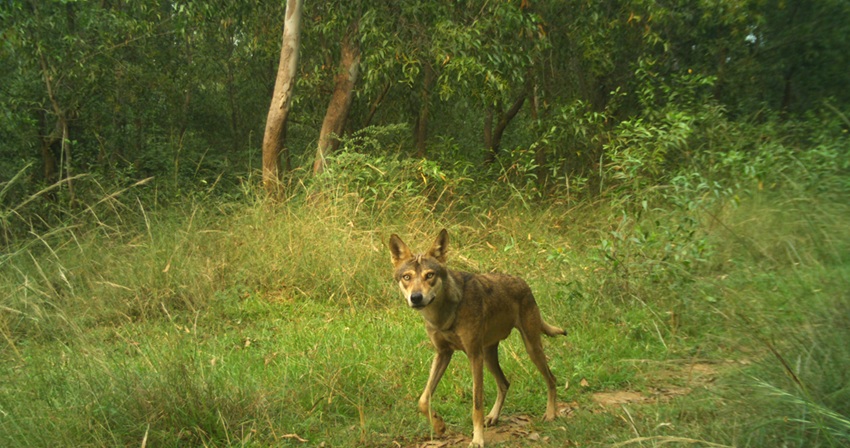
Nine camera-trap locations were selected after tracking and consultation with villagers. The cameras produced fifty-eight wolf images. Most photographs were taken in areas near water bodies, which are essential resources in summer and early winter. Several images captured wolves patrolling in pairs or small groups. The behaviour suggested regular marking, boundary checks, and coordinated movement between adults and subadults.
A few images were especially valuable because they showed clear morphological characteristics that helped identify individual wolves. One adult male had a damaged eye, and one adult female was missing a hind paw. These unique features allowed researchers to recognise specific wolves and better understand the pack’s composition.
The camera traps also recorded fishing cat, jungle cat, Indian grey mongoose, small Indian civet, Indian hare, wild boar, Indian peafowl, and other species. These records provided not only a picture of the potential prey base but also highlighted the wide variety of faunal wealth in the area. At the same time, images of suspected poachers revealed ongoing threats from illegal hunting. The forest department was alerted regarding these incidents.
Researchers also conducted semi-structured questionnaire surveys with villagers, nomadic herders and forest guards. These interviews provided information on livestock loss, wolf movement and conflict incidents. They also revealed that awareness of wolves was initially low.
A closer look at the pack
The pack in Madhaiganj included three adult males, two adult females, two subadults and three juveniles. The juveniles were photographed for the first time between April and May 2023. Their presence highlights the importance of this habitat as a breeding ground for this vulnerable species.
Mukherjee emphasised the importance of these observations. “We are only beginning to understand how unique this apex predator is. Every dataset from underreported regions like eastern India helps shape future conservation policy.”
Natural prey species for wolves, such as blackbuck and chinkara, do not occur in eastern India. As a result, wolves depend mostly on livestock, especially goats and sheep, and they also survive through opportunistic scavenging. This dependence increases the chances of conflict with people. Land conversion, mining operations, scrubland clearing, and continuous hunting pressure further limit the natural prey base in Madhaiganj. Due to these factors, more than half of the surveyed households reported losing livestock in the previous year.
A local village resident, Bikash Roy, said, “We do not want harm to come to wolves because they are part of this land. But when our animals are taken, our families suffer. If we receive support and if our enclosures can be safer, then coexistence is possible.”
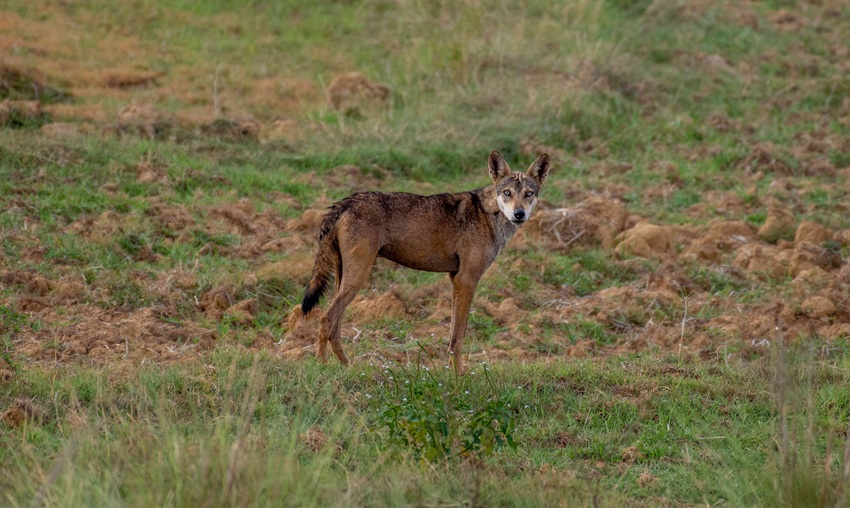
His view represents the situation of many families in the region who experience financial strain after livestock losses.
Habitat under stress
The region around Madhaiganj has undergone rapid change over the past three decades. Studies by Choudhury et al in 2019 show that settlement areas in Paschim Bardhaman have grown while forest and scrub cover have declined. Wolves depend on grasslands, scrublands and open forests, but these habitats are now fragmented.
Mining in the region, mainly by Eastern Coalfields Limited, continues to expand. This breaks the habitat into smaller patches, restricting wildlife’s free movement. Small and isolated carnivore populations can face the risk of inbreeding depression, which may create population bottlenecks and reduce their long-term survival.
Divisional Forest Officer (DFO) Durgapur, Anupam Khan, described the management challenges in this landscape.
“This region is a mosaic of mines, industries, rivers, villages and forest patches. Wolves are adapting to it, which means our management must adapt as well. This study helps us identify corridors, conflict hotspots and areas where community outreach is urgently needed.”
He also stressed the importance of coordinated conservation. “Conservation here must be collaborative. Forest staff, researchers, local people and industry must all participate. Wolves have survived here for decades. What we need now is structured and data-driven management so that they can survive for decades more,” he added.
Way forward
The study highlights the need for region-specific conservation strategies for the Indian wolf. The species does not rely on dense forests and often survives in open habitats that are rarely prioritised in conservation programmes.
Future research in the region could include non-invasive DNA sampling to estimate population size, identification of genetic diversity, and study of diet composition. Radio collaring could also help identify movement corridors and safe routes through human-occupied areas.
Mukherjee explained the broader significance of these actions. “This pack maintains a much smaller territory compared to packs in western India because livestock is easily available as prey. But without proper planning, these remaining pockets of habitat may not survive in the long run. If these areas are not recognised and protected in time, we may risk losing them forever.”
The Madhaiganj study shows that Indian wolves continue to survive in challenging, human-dominated landscapes in eastern India. With only around 3,000 wolves remaining across the country, each stable pack becomes extremely important.
The survival of wolves in this landscape depends on stronger forest department vigilance, active community support, better livestock protection, thoughtful habitat management and long-term research. With proper planning and effective policymaking, coexistence can continue, and the future of this threatened species can be made more secure and sustainable.
The author is one of the co-authors of the study and is the Joint Secretary of the Wildlife Information and Nature Guide Society.
Citation:
Choudhury, D., Das, K., & Das, A. (2019). Assessment of land use and land cover changes and its impact on variations of land surface temperature in Asansol-Durgapur Development Region. The Egyptian Journal of Remote Sensing and Space Sciences, 22, 203–218.
Hennelly, L. M., Khan, S., Sadhukhan, S., Sarwar, G., Yellapu, S., Viranta, S., Jhala, Y. V., & Habib, B. (2025). Canis lupus ssp. pallipes. The IUCN Red List of Threatened Species 2025: e.T223987953A223987966. https://dx.doi.org/10.2305/IUCN.UK.2025-2.RLTS.T223987953A223987966.en
Jhala, Y., Saini, S., Kumar, S., & Qureshi, Q. (2022). Distribution, status, and conservation of the Indian peninsular wolf. Frontiers in Ecology and Evolution, 10, 814966.
Kardos, M., Taylor, H. R., Ellegren, H., Luikart, G., & Allendorf, F. W. (2016). Genomics advances the study of inbreeding depression in the wild. Evolutionary Applications, 9(10), 1205–1218.
Mukherjee, A., Chattopadhyay, M. K., Bose, A., Adhurya, S., Khan, A., Das, K., & Bhowmick, G. D. (2025). Towards coexistence – An integrated approach for wolf conservation, population monitoring, and mitigating human-wolf conflict. Journal of the Bombay Natural History Society, 122(3). https://doi.org/10.17087/jbnhs/2025/v122/170907
Saren, P. C., Basu, D., & Mukherjee, T. (2019). Status survey of Indian Grey Wolf (Canis lupus pallipes) in West Bengal and some parts of Jharkhand. Records of Zoological Survey of India, 119(2), 103–110.
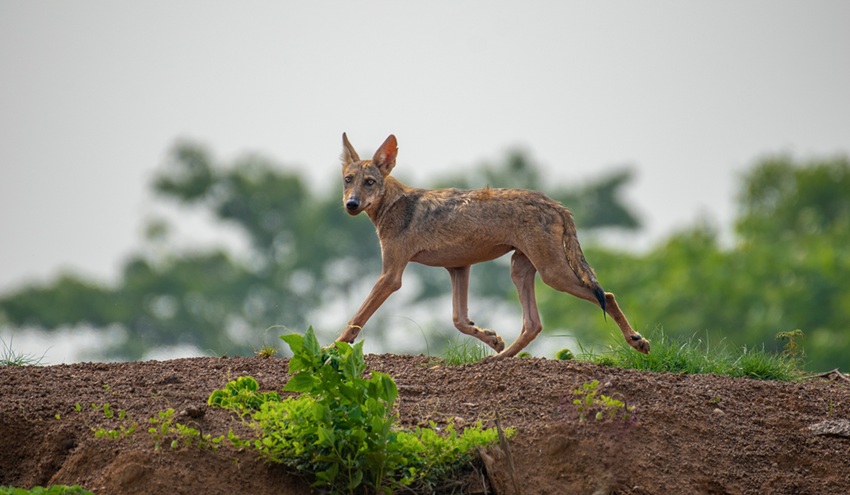
Banner image: A sub-adult Indian grey wolf photographed at Madhaigunj in May 2024. Image by Manish Kumar Chattopadhyay.
Credits