- Bailadila hills in Chhattisgarh is home to one of India’s last few clusters of the ancient tree fern Alsophila spinulosa.
- National steel expansion plans place new mining directly inside the fern’s habitat.
- Experts and tribal communities warn that mining could disrupt water sources and push the Jurassic-era fern toward extinction in the area.
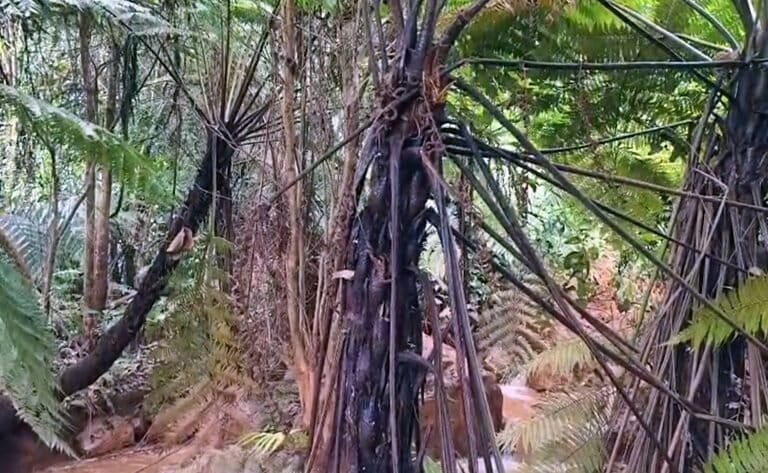
Deep inside the tribal landscape of Bailadila hills in Dantewada district of Chhattisgarh, a fern from an older chapter of Earth’s history grows in scattered clusters along shaded slopes and perennial streams. But this rare species is losing its fragile habitat as mining expands deeper into the forests. With a renewed push for iron ore extraction, many fear that this ancient plant is now at risk of extinction in the region.
Considered a living fossil, the fern is significant in the scientific community for understanding the evolution of trees. Its origins date back to the Carboniferous (about 420 to 300 million years ago) and Triassic (about 251 to 200 million years ago) periods, when early forests were forming. While many related species vanished during mass extinction events, some lineages survived and continued. This fern is one of those few that survived.
It means the fern, scientifically known as Alsophila spinulosa, carries a genetic line that has changed little over millions of years. This is one of the few ferns that form a tall, woody stem and grow like a small tree, supported by a trunk that can reach several metres in length.
In the local Koya dialect, the fern is known as Handa Kusir; its tender leaves are eaten, and people show a distinct attachment to it. However, with the in-principle forest clearance granted in June this year, experts and locals warn that habitat loss could lead to the tree ferns disappearing from the area.
Ballu Bhogami, District President of the Koya tribe, told Mongabay-India, “Tree ferns are found only in a few regions — the Himalayas, the Nilgiris, and the Bailadila hills of Bastar. If their habitats are disturbed, we will lose them. Our community will protest if needed to protect them.” He informed that the tribal communities held a meeting in August and decided to oppose the project. They subsequently submitted a formal petition to the district authorities opposing the opening of Deposit-4 for mining purposes.

Ancient ferns, modern danger
These tree ferns thrive in marshy, moist soils and can reach heights of more than 10 metres, which is usually attained in many years. Bacheli Forest Ranger Ashutosh Mandava said that a plant’s age can often be estimated by its height. Earlier, the habitat of the tree ferns was found in most parts of the Bailadila hills in Dantewada district; however, it is now confined to reserve forests (under the Bacheli range) on the mountain along Gali nallah (rivulet).
Researchers see the species as an important link between prehistoric flora and modern plant groups. Gregory Moore, former Principal of Burnley College at the University of Melbourne and a leading expert in arboriculture and urban tree management, told Mongabay-India, “A. spinulosa has an interesting genome where there seemed to be a doubling of chromosomes about 100 million years ago, but it has been very stable genetically since. Like many ferns, this species has a complex vascular anatomy which may give insight into how woody species developed and evolved.”
Despite belonging to an ancient lineage, tree ferns are still poorly studied, and their genetic and physiological traits remain largely unexplored. Scientists consider them living windows into plant evolution, with roles in maintaining moisture, stabilising soil, and supporting understory biodiversity.
Among the roughly 230 species of Alsophila identified globally, 68 species were listed in the International Union for Conservation of Nature (IUCN) Red List in 2010. It highlights the crisis the fern faces and the urgency of stronger protective measures, especially as deforestation and mining increasingly threaten its fragile habitats.
Experts warn that A. spinulosa faces multiple threats. Shweta Singh, a plant taxonomy expert who was associated with the Botanical Survey of India in the past, and has worked on tree ferns, says, “A. spinulosa, surviving in only a few forest patches in India, faces threats from mining, deforestation, and human activity. Protecting its natural habitats through legal in-situ conservation is essential to maintain ecological integrity. Simultaneously, ex-situ cultivation in nurseries and botanical gardens can preserve genetic material and allow reintroduction into secure areas.”
Iron ore ambitions
The same habitat in Bastar region of Chhattisgarh, the Bailadila range, a long north–south forested hills in southern Chhattisgarh, has been at the centre of India’s iron ore production for more than half a century. The range contains 14 major deposits, mapped and numbered by early surveys. Only four of these — Deposits 5, 10, 11, and 14 — have been developed by NMDC Ltd., a public sector company and India’s largest producer of iron ore, leaving most of the remaining deposits untouched despite extensive exploration. Among them are Deposits 4 and 13, both studied in detail and now part of the country’s expansion plans.
These plans have renewed concern for an area of particular ecological value: the Galli Nala region, which lies to the east of the Bailadila Iron Ore Deposit-4. This patchwork of perennial streams and marshy soil shelters some of the densest known populations of A. spinulosa in India.
A forest department survey recorded 368 individuals within the proposed project area and another 295 in the surrounding forest compartments, confirming that this single stretch of Bailadila holds more than 650 mature tree ferns — one of the species’ strongest surviving populations in the country.
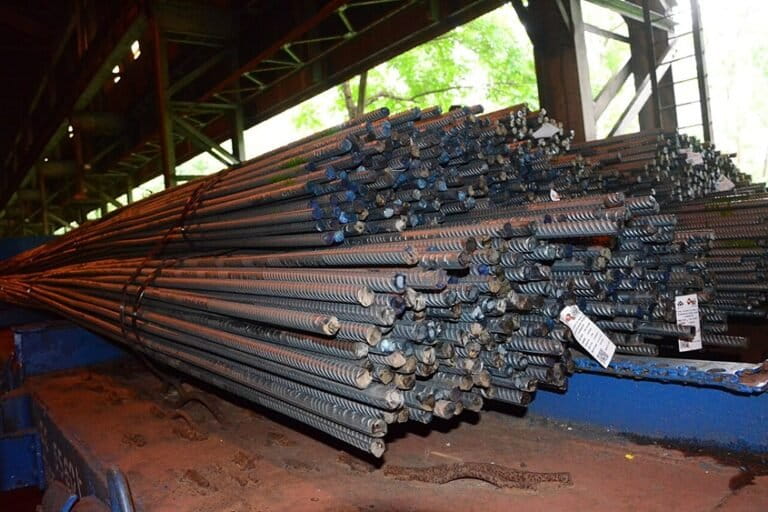
The pressure on this landscape is tied to India’s growing steel demand. In 2022–23, the country produced about 127 million tonnes of steel. Under the National Steel Policy (NSP) 2017, India aims to raise its production capacity to 300 million tonnes (MT) by 2030. Meeting this target will require 400–450 MT of iron ore annually by the end of the decade, rising to about 570 MT by 2047.
To support this, the Ministry of Steel has asked NMDC Ltd. to increase its iron ore production capacity, and the organisation aims to reach 100 MT a year by 2030, of which 86 MT is expected from the Bailadila sector alone. This expansion will involve opening new deposits, such as 4 and 13, along with scaling up operations in existing mines. Bailadila’s high-grade ore — requiring less processing — makes it central to these plans.
Chhattisgarh is expected to be a key contributor. Under NSP-2017 projections, about 25% of India’s iron ore supply, roughly 112 MT each year, should come from the state by 2030. Bailadila currently accounts for nearly 75% of Chhattisgarh’s output and more than 99% of its non-captive production. To meet national targets, the region will need to supply around 84–85 MT annually, bringing mining into areas that overlap with key habitats of A. spinulosa.
A fresh proposal submitted in 2024 was later approved by the Union Cabinet, reviving iron ore mining in the same deposit where the tree ferns are found.
Will the checks work?
Tribal communities warn that mining waste, work camps, and the disturbance of natural streams will put the ferns at immediate risk. Their survival depends entirely on constant moisture; if the perennial flows around Galli Nala are disrupted, the plants could disappear from the region.
In 2023, the forest department asked the Indian Council of Forestry Research and Education (ICFRE) to study the species and recommend protective measures, informed Jadhav Sagar Ramchandra, Dantewada Divisional Forest Officer (DFO).
He told Mongabay-India, “For the Bailadila Deposit-4 mine of NMDC-CMDC Ltd., the user agency must ascertain a safe distance from the existing tree fern habitat before carrying out mining activities and infrastructure development. The recommended safe distances are 150 meters towards the west and 191 meters towards the east of the Galli Nalla bank for mining operations, subject to strict adherence to the environmental protection measures suggested in the ICFRE report.”
“Since mining would be conducted in alternate time spans, periodic studies would be carried out to ensure that the moist areas remain safe and to assess the impact on the tree ferns,” Jadhav added.
However, the current pursuit of mining at Deposit-4 represents a dramatic reversal of the Central Government’s own mandate. Official documents confirm that the proposal was rejected in 2017 because it “would have an adverse impact on the local ecological regimes, especially water and tree fern,” further noting that the user agency had sufficient iron ore reserves elsewhere.
The present revival of the project under a new joint venture, justified through the National Steel Policy 2017, reverses that earlier assessment. Even the State Government’s submission in the current proposal acknowledges that mining will have a “negative impact on tree-ferns.”
The requirement for a scientific determination of “exact safe distances” is itself an indication that the lease area overlaps areas critical for the species. The hydrological balance of the Bailadila hills — formally recognised in earlier regulatory reviews — is central to the fern’s survival. The 2017 rejection cited the risk to both the ferns and the water sources that support them, emphasising that the species is tied to the unique microclimate created by dense forest cover and perennial streams such as Galli Nala and Sankani Nadi, Ballu Bhogami said.
He added that mining on this scale brings the risk of altering sub-surface water flows, destabilising aquifers, and reducing the moisture levels that the ferns rely on.
Residents believe that the fragmentation of forests, coupled with changes in water and soil quality, can push species like A. spinulosa towards extinction, Ballu Bhogami told Mongabay-India.
A retired official from the Indian Forest Service from Raipur, S.K. Singh, said the tree ferns of Bailadila are “living archives of Earth’s deep history,” representing evolutionary pathways that predate flowering plants. Their presence along Galli Nala is a reminder of an ecosystem shaped over millions of years. “Protecting them is not simply about preserving a species,” he said, “it is about preserving a living chronicle of Earth’s evolutionary and cultural history.”
Read more: Iron ore mining in Chhattisgarh drives deforestation
Banner image: Often called ‘living fossils’, the fern Alsophila spinulosa is found in the Bailadila hills of Dantewada district, Chhattisgarh. Image by Devendra Shukla.
Credits