

- As the central government promises free solar power, Maharashtra’s state-level tariff reforms leave consumers uncertain.
- Consumers fear that the state’s proposed night tariff and frequent policy changes will make solar power unaffordable and unpredictable.
- With uncertainty in Maharashtra’s rooftop solar sector, experts are calling for long-term, consistent policies and solutions like battery storage systems to protect consumers and rebuild confidence in clean energy investments.
Maharashtra’s solar energy plans are facing a policy clash. The central government’s PM Surya Ghar Yojana aims to expand rooftop solar by offering households up to 300 units of free electricity each month, while the state government is considering a night-time tariff hike to manage its power distribution costs. Many consumers who turned to solar power to cut their electricity bills now worry that new rules will make clean energy less affordable.
“We currently only pay ₹130 a month, but we have no idea how much they may charge us in the near future,” says Chandrakant Shelke, a 49-year-old farmer from Shelkewadi. “With new laws, who can predict how the government will tax us and modify the tariff?”
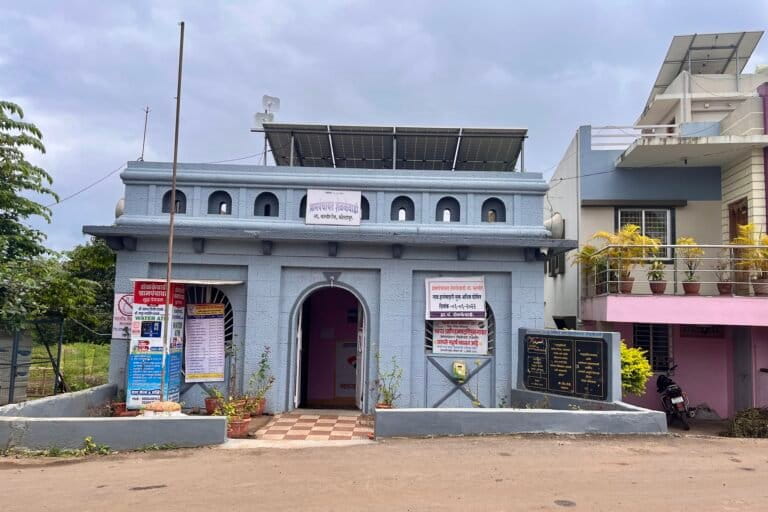
Shelkewadi is a 100% solar-powered village in Maharashtra’s Kolhapur district. It is a model village, self-sufficient in solar energy, progressive, and known for its clean energy status. However, the villagers are now worried with the Maharashtra State Electricity Board’s (MSEB) proposed changes in time-of-day (ToD) tariffs. They worry that these charges could undo their years of efforts in clean energy.
This uncertainty is not just confined to one village. Across Maharashtra, many consumers with rooftop solar, small-scale resellers and commercial users are confused about the state government’s shifting strategy and new charges. Industrial and commercial rooftop solar (RTS) consumers are struggling with no offset benefit, prolonged payback periods and heavy upfront investment for renewable energy.
Regulations favour large-scale utilities, say entrepreneurs
The state electricity board and regulating commission in Maharashtra have proposed a new time-of-day structure in the electricity regulations. Under the proposal, electricity generated by rooftop and other solar would be priced at the lowest between 9 am to 5 pm. But the excess solar power generated, which the consumers would typically send to the grid expecting to use it at night-time, would now be available at a higher rate. In effect, solar consumers would face a night tariff hike.
Currently, any extra electricity generated by the individual consumers is sent to the state grid. Consumers later draw power from the grid, and their exported daytime units are credited against what they use at night. With the new regulations, the way this extra solar energy is saved and used later, and the financial impacts on the consumers, could change.
According to rooftop solar entrepreneurs, these regulations are not consumer-friendly, and favour large-scale utilities and benefit discoms (distribution companies). Those who have installed solar, expecting net metering and other benefits, may find it unviable and it will lower the incentive for installing rooftop solar.
Rajendra Patil, a solar entrepreneur, said, “The Maharashtra government recently announced an additional incentive of up to 30% subsidy for rooftop solar consumers who are below the poverty line and are consuming less than 100 units per month. But MSEB has also proposed that solar-generated electricity offset only during off-peak hours, in daytime. Because of that, rooftop solar consumers cannot offset (balance out energy use) during evening peak hours, which are when most homes and commercial establishments use power.” In effect, consumers cannot use solar power generated earlier in the day to balance out night time usage.
He added that rooftop and open access consumers are targeted by MSEB in such a way that they cannot get an offset, while the discoms continue earning revenue after installing solar rooftop. “Meanwhile, MSEB and the state government are favouring and promoting utility-scale solar plants that benefit discoms.”
This ToD structure will effectively discourage rooftop adoption and lengthen the payback period in Maharashtra.
Patil further argues that the regulations are changing swiftly, creating ambiguity and lack of trust in the state discom, as well as its amended norms and regulations. “The rooftop solar has already had an impact on MSEB’s earnings,” he says, “and that’s why the discom is implementing new revenue-generating strategies by blocking rooftop consumers from receiving benefits.”

Policy contradiction between state and Centre
The central government’s rooftop solar policy and funding assistance under the rooftop solar scheme PM Surya Ghar Yojana were designed to scale up rooftop solar installations across India. However, state-level discoms incurred losses in revenue and started struggling. Over the past few years, they have introduced banking charges, peak hour variable rates, and exclusions for industrial and commercial consumers.
“The discom is indirectly opposing rooftop solar by putting unfair laws to dissuade or restrict consumers, resulting in solar becoming uneconomical,” Patil claims. “This is a breach of the original agreement between rooftop consumers and Maharashtra State Distribution Company Limited (MSDCL), which was to provide zero bills or only meter rentals. Now, consumers are being billed for peak-hour usage, except for residential consumers as of 2025.
A petition filed by Sudhir Budhay, a renewable energy consultant, and the National Solar Energy Federation of India, has challenged the grid support and banking charges, warning that this may cause up to 30% decline in new rooftop solar installations.

State’s unstable policy on rooftop solar
From 2.82 GW in 2014 to 100 GW in 2025, India’s solar power capacity has grown by 3,450 % in this time period. But this growth has come with a cost — state discoms’ declining revenues. In response, many states, including Maharashtra, have started revising consumer tariffs to recover losses.
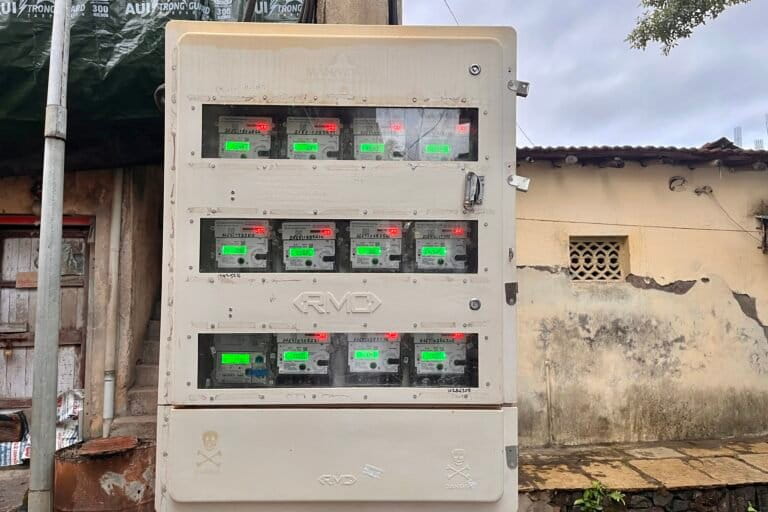
“The smart meter implementation policy encourages consumers to use solar energy during solar hours, while the discom buys power at higher rates during off-solar hours and forces users to pay bills for peak-hour usage,” said Samir Gandhi, a solar energy advocate from Pune. “They are moving the goalposts, asking you to use solar, but then increasing tariffs for using grid power once the sun is down.”
He added that commercial and industrial customers who invested in rooftop solar installations in 2022-2023 face the same one-sided agreement modification. “Consumers are afraid to trust the government, and it appears the government is modifying policies for political motives without including the consumer.”
Ajay Jain, a financial expert from Indusbridge, expressed concerns, saying that investors look for long-term, stable policies to safeguard their investments. “The same mistrust is visible with smart meters, so the public is concerned about the government’s intention to install it.”
Battery storage to combat tariffs
As energy pricing becomes more dynamic, Battery Energy Storage Systems (BESS) are emerging as a practical solution to rising tariffs.
Bhavani Singh Rathore, a renewable energy coach with expertise in BESS, said, “The pattern of solar and non-solar hours has changed; the ToD reform has a dual effect on rooftop solar systems. This creates an imbalance. Consumers can use this self-generated energy effectively. Whereas energy consumed after the sun goes down falls in high-tariff hours. Without storage, consumers are forced to buy expensive grid power.”
He also spoke about a possible solution to compensate inflated energy bills. “By adding even a small BESS setup, consumers can store self-generated solar energy during the day (9 am–5 pm) and discharge it during expensive peak hours. “This lets them avoid high-cost electricity during peak hours and benefit from solar round-the-clock. Integrating lithum-ion BESS with a proper energy management system is key.” Rathore added that Maharashtra has become India’s testing ground for real-time energy intelligence, and those who adopt storage early will lead the transition toward net-zero energy lifestyles.
This story was produced with the support of Internews’ Earth Journalism Network.
Banner image: Tejashri Shelke, the sarpanch of Shelkewadi, stated that all of the homes in the ‘Pink Village’ are owned by women and symbolically painted pink. Shelkewadi is a 100% solar-powered village, but they are now worried with the Maharashtra State Electricity Board’s proposed changes in energy tariff structure. Image by Abhijeet Gurjar.
Credits


