- A new study which used satellite data finds the frequent occurrence of snow droughts and their hotspots across 11 major river basins in the Hindu Kush Himalayas, and a decline in snow cover days.
- The findings also reveal that elevations between 3,000 and 6,000 metres are particularly vulnerable due to elevation-dependent warming.
- While snow droughts have received limited attention in the Himalayan region, scientists warn that they could have far-reaching impacts on both people and the environment.
On a cold January morning in the high-altitude region of Spiti in the Indian Himalayas, a team of researchers set out to study the disappearing snow in the mountains. Along the trail, they stopped to talk with yak herders who had spent their lives watching the snow come and go. The herders spoke of winters growing shorter and warmer. Their yaks had even begun breeding earlier, a change they had never seen before.
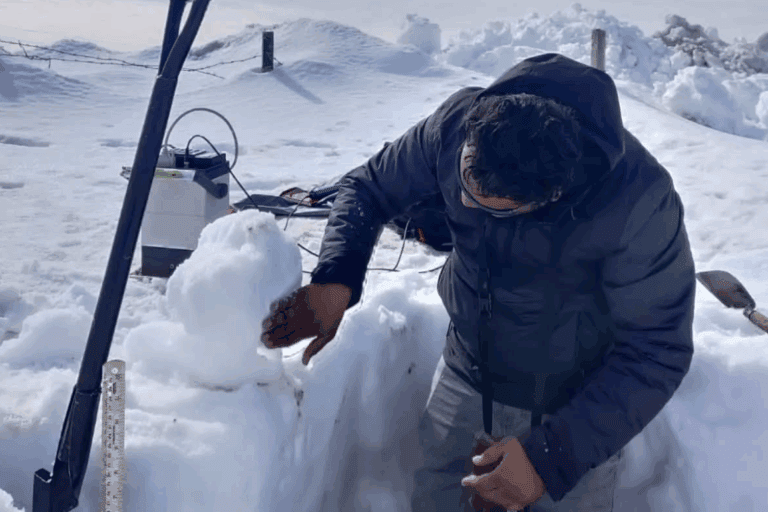
When the researchers collected snow observation details in the Dundhi area and the Bathad village of the Kullu district in Himachal Pradesh, the local residents told them that the region used to receive more than five metres of snow each winter. Now, snowfall had drastically reduced to just a few centimetres or around one metre, which affected agriculture yields. Here, they recorded snow depths of only 40-50 cm in the month of January.
The team observed that the lower layer of the snowpack (snow on the ground in mountainous areas that persists until the arrival of warmer weather) was already wet, indicating early snowmelt that would normally occur in spring. “These local accounts mirror what we describe as a transition from snow-rich winters to snow-deficient ones, a clear sign of evolving snow drought conditions in the Himalayas,” Hemant Singh, a researcher at Department of Civil Engineering in the Indian Institute of Technology (IIT) Jammu says, who is currently pursuing Ph.D. on snow and glacier hydrology and associated hazards.
A recent study published by Singh and his colleagues in the journal Scientific Reports, finds snow droughts are on the rise in the Hindu Kush Himalayas. A snow drought is defined as a significant lack of snowpack (standing snow over the ground) for a given time of the year which distinguishes it from other types of hydrological and meteorological droughts. They are classified into two main types: Dry snow drought and warm snow drought. The former is caused by below-normal winter precipitation. It means that not enough snow falls during winter. The latter occurs when precipitation is near normal, but temperatures are too warm, causing it to fall as rain instead of snow or leading to early snowmelt.
The study reveals that major river basins, including the Indus, Mekong and Amu-Darya, are experiencing shorter snow cover periods and weaker snow persistence, especially at 3,000-6,000 m elevations, making them highly vulnerable to warming.
Understanding snow droughts in the Hindu Kush Himalayas
In the Hindu Kush Himalayas (HKH), snow is vital for rivers, ecosystems, and the water security for two billion people across eight countries — India, China, Nepal, Bhutan, Pakistan, Afghanistan, Myanmar, and Bangladesh. But in recent decades, snowfall has been declining sharply, with snow melting earlier and snow cover days dropping by about five days per decade. Data shows that the HKH is warming faster than the global average, causing snow lines to shift upward and major basins like the Brahmaputra, Ganga, and Indus to lose 30–70% of snowfall in future projections. This decline threatens water supply, agriculture, and livelihoods for millions who rely on snowmelt.
Singh’s study highlights the frequent occurrence of snow droughts and their hotspots across 11 major river basins, along with a decline in snow cover days (DSCD) in the Hindu Kush Himalayas. To analyse these drought events, the researchers used snow cover satellite data and reanalysis data from 1999 to 2016.
According to Singh, most snow droughts were observed in the North-West, Amu Darya, Indus, Ganga, Mekong, and Salween basins, which also experienced a significant decline in snow cover days. The Amu Darya and North-West basins, located in Afghanistan, particularly the northern, northeastern, and central highland regions, emerged as hotspots for snow droughts. Similarly, Ladakh, Himachal Pradesh, and Jammu and Kashmir within the Indus and Ganga basins also experienced snow drought. In China, Xizang Zizhiqu and Qinghai Sheng, covering parts of the Salween and Mekong basins, were also affected.
The findings indicate “moderate to severe snow droughts were observed in 2008, 2011, 2015 and 2016 in the North-West (NW), Amu-Darya (AD), Indus (IN), and Salween (SA) and Mekong (MK) basins with strong linkages to DSCD (the declined snow cover days) and SCPA (snow cover persistence anomalies).”
The results also reveal that elevations between 3,000 and 6,000 metres are particularly vulnerable due to elevation-dependent warming. “In these mid-elevation zones, rising temperatures may be causing less precipitation and rain events instead of snow, reducing snow accumulation and increasing the frequency of snow drought events,” Singh says.
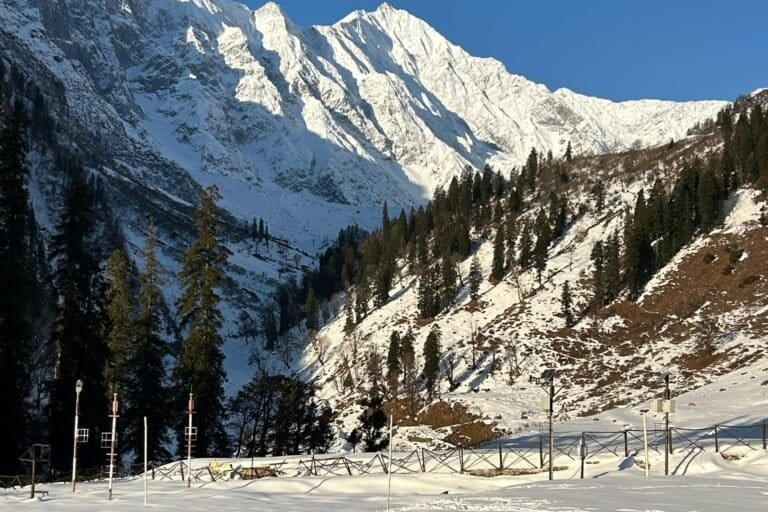
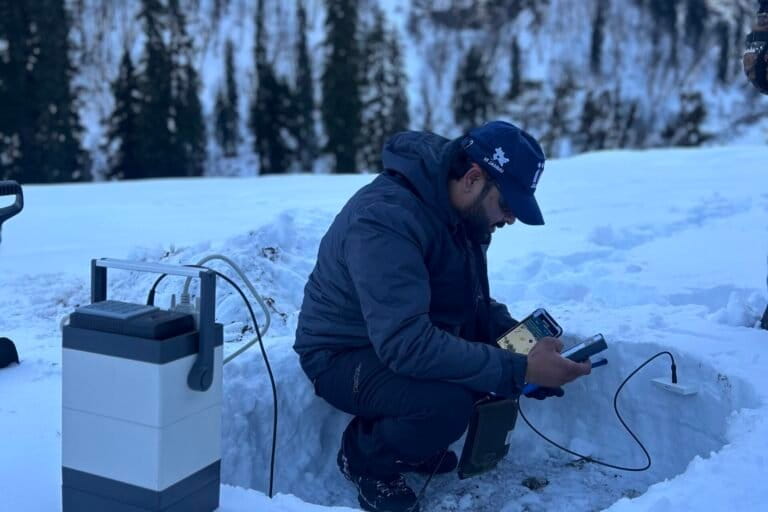
But snow droughts have received limited attention in the Himalayan region. “First, most existing studies rely on coarse-resolution datasets, which are insufficient to capture snow dynamics particularly in the complex Himalayan topography,” Singh explains. He adds, “Second, there is a significant lack of in-situ observations (ground measurement) of snow parameters, such as snow depth, snow water equivalent (it represents the amount of water contained in the snowpack), and precipitation phase. This scarcity of ground-based data limits the scientific community to study and monitor snow droughts in this region.”
Mehnaz Rashid, a lecturer of Environmental Management and Sustainability at the University of Teesside, in the U.K., who is not associated with the study, says the research paper is a standout contribution to our understanding of the Hindu Kush Himalayas, clearly showing that snow cover in the region is declining rapidly, primarily because of rising temperatures.
“Snow droughts are becoming more frequent and severe, putting the water supply of millions at risk. The research excels in pinpointing the worst-affected areas and establishing a strong connection to climate change. However, the study would have been even stronger if it included data from the most recent years. Nevertheless, this is an important piece of research that raises urgent concerns and should prompt immediate action from policymakers and affected communities,” Rashid says.
RAAJ Ramsankaran, a professor at the department of Civil Engineering in the Indian Institute of Technology Bombay says that the research paper emphasises the critical need for the monitoring of snow droughts in the HKH region. “This is imperative for regional water management, hydrological modelling, agricultural practices, and hydropower studies,” says Ramasankaran who was also not involved in the study.
What global trends reveal
Globally studies show that by 2100, snow droughts could become three to four times more common than they were in the 1980s, with the warm type making up nearly two-thirds of all snow droughts by mid-century. The frequency of warm and dry-warm snow droughts is projected to rise by up to six times.
For example, in winter 2015, the U.S. West Coast experienced a classic warm snow drought, characterised by near-normal precipitation but record-low snowpack. “This was due to storms falling as rain at elevations where snow typically accumulates, sharply reducing spring meltwater and complicating water management decisions, such as those at Oroville Dam,” Rashid shares. “In contrast, parts of the Alps in 2022 were closer to a “snowmelt drought” scenario where low winter accumulation and hot conditions led to exceptionally weak spring-summer meltwater, contributing to a 25-year low in Alpine hydropower production by mid-summer 2022,” she continues.
The warming is shifting precipitation from snow to rain in the high mountain areas like the Himalaya, raising the snowline, reducing the percentage of precipitation that falls as snow, and shortening the seasonal duration of snow cover, especially at mid-to-high elevations, which are very sensitive to small temperature changes, Rashid explains.
This year’s report on Hindu Kush Himalaya (HKH) by the International Centre for Integrated Mountain Development (ICIMOD) confirms this transformation, reporting a consistent 24% decline over the last three years in seasonal snow cover across the region and this is the lowest of the last 23 years, warning of serious implications for downstream water availability. “This is a clear signal of how warming is reshaping the cryosphere (cryosphere refers to earth’s ice in all its forms, like snow, lake and river ice, frozen ground), and hydrology of one of the world’s most critical mountain regions,” Rashid says.

Impact of snow droughts and adaptation strategies
According to the scientists, snow droughts have far-reaching impacts on both people and the environment. In summer, the reduced snowmelt leads to lower streamflow, which in turn affects reservoir water storage, drinking water supply, agricultural and horticultural needs. Also, the hydropower systems dependent on predictable spring-summer inflows face reduced generation and operational constraints.
During winter, due to climate warming, precipitation increasingly falls as rain instead of snow, and rain-on-snow events become more frequent. These changes complicate water management and contribute to more extreme hydro meteorological events. “Additionally, tourism and recreation sectors suffer, as ski resorts and winter sports industries face major losses during seasons with little or no snow,” Ramsankaran says.
To address the growing risks from snow droughts in the Himalayas, the most effective strategies involve a combination of technical, institutional, and nature-based measures, according to experts. “Priorities include investing in seasonal water storage infrastructure, upgrading irrigation and water efficiency technologies, and preparing robust cross-sectoral drought management plans. Evidence-based decision-making, anchored in real-time monitoring and regional data sharing, will be key to effective adaptation,” Rashid notes.
She adds, the policy makers can take inspiration from the Alps and Rockies, which have demonstrated the value of flexible reservoir operations, coordinated response planning, nature-based solutions such as ecosystem restoration, and strong public engagement in adaptation efforts. “Adopting integrated water management, community-led initiatives, and adaptive planning from these regions could greatly enhance the Himalayan response, making it more resilient to climate-driven snow droughts,” Rashid says.
Manzoor Ahmad Shah, a professor of Ecology at University of Kashmir says that there is credible scientific evidence for climate change-driven rapid melting of Himalayan glaciers and its implications for biodiversity and ecosystem functioning are yet to be fully understood. “We need a pan-Himalayan coordinated distributed experimental approach, setting up long-term ecological observatories and serious policy level interventions to check this trend,” Shah notes.
Read more: Unreliable snow threatens winter tourism
Banner image: To address snow droughts in the Himalayas, experts suggest investing in seasonal water storage infrastructure, upgrading irrigation and water efficiency technologies, and preparing robust cross-sectoral drought management plans. Image by Hemant Singh.
Credits