- Concretisation and repeated excavation are damaging tree roots, weakening their ability to withstand strong winds and heavy rain.
- Unscientific pruning and gaps in civic tree management are leaving structural risks unaddressed.
- Experts say Mumbai needs a fundamental shift in how it plans and manages urban spaces, treating trees as part of the city’s ecosystem rather than obstacles to development.
Earlier this year, when Mumbaikars hoped the monsoon would end the heatwave, heavy rains and gusty winds turned the city’s tree-lined roads into hazard zones. Now, the monsoon in Mumbai does not just mean floods; it also means fearing that the next tree to fall could be the one you’re walking under.
In a span of a week in June-July, three people died in separate tree-related incidents. On June 30, 11-year-old Vihaan Srivastava died when a 60-year-old tree fell on the school bus he was on, in Chembur. Kumar Hasan Raza Jahangir Alam Syed, 18, died when a large tree branch struck him while he was riding a motorcycle in Aarey Colony, on July 5. On the same day, Yunus Kundawala, 63, died after he was struck by a falling tree in Kurla.
Between June 22 and July 17, 902 trees have been uprooted, and 1,251 branches have fallen across public spaces in Mumbai. July 5 and July 6 recorded the highest single-day figures during the rain, 203 and 523 tree-fall incidents, respectively. Data from the Brihanmumbai Municipal Corporation (BMC) shows 655 tree falls in 2022, 687 in 2023, 653 in 2024 and 855 in 2025.
This year, on July 7, BMC commissioner Ashwini Bhide, in a press conference, said concrete roads alone are not the cause of the problem, and attributed the tree-falling incidents to strong winds.
According to the India Meteorological Department (IMD), gusty wind speeds reached 70-80 kilometres per hour between July 6 and July 7. However, experts point out man-made issues such as concretisation, unscientific pruning, repeated excavation for utility work, and civic apathy as the prime reasons.
Poor urban design and planning
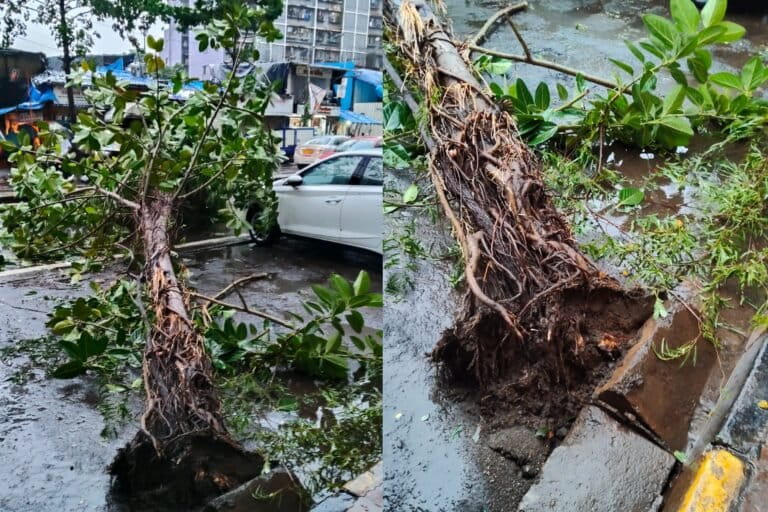
When a tree base is paved or concretised, it restricts oxygen and water from infiltrating the root zone, preventing it from spreading naturally for anchorage. Over time, this reduces the tree’s structural base significantly even though the canopy above may look unaffected. This makes paved-in urban trees vulnerable to uprooting in high wind or saturated soil conditions.
While some trees had damaged roots, some were uprooted completely. But most stood along sidewalks and footpaths, where their root systems are particularly vulnerable to construction activity.
Stormwater drains often run along the same stretches of road where trees are planted. “Whenever a road is concretised, the stormwater drain beneath or alongside is often dug up as well,” said Abhijit Ekbote, an urban practitioner. “Since these drains are reinforced cement concrete (RCC) boxes that carry rainwater, roadwork usually involves digging up the adjoining footpath too. All of this is included in the same contract. So, the larger the scope of work, the bigger the contract and the entire road, drain and footpath end up being revamped together.”
He added that when an old drain is replaced or a new one is built, the ground must be excavated. “This can cut through or disturb the roots, weakening the trees’ support system for those trees which are growing on or along the sidewalk.”
Repeated excavation work for utility purposes across the city disrupts the root system of trees in the area. Vaibhav Raje, an arborist, said “It compounds damage before roots can recover. This cumulative, largely undocumented root loss is one of the most underappreciated causes of tree failure in dense urban corridors.”
In 2015, Vanashakti, a non-profit, approached the National Green Tribunal (NGT) over the concretisation of tree bases in Mumbai. In a July 28 order, the Tribunal directed that the de-concretisation programme be implemented in a phased manner, ward by ward, and not selectively.
In 2023, Thane resident and petitioner Rohit Manohar Joshi had filed a public interest litigation (PIL) in the Bombay High Court, seeking a uniform policy for compensation and compassionate employment for victims and the kin of those injured or killed in tree-fall incidents, as well as the de-concretisation of trees in Thane. The court directed the Thane Municipal Corporation (TMC) to de-concretise over 7,400 trees within 45 days. The court also made BMC a party respondent. Years have gone by, but the work is still pending.
Earlier this year, the court directed a joint inspection by the two corporations. Thane and Mumbai’s garden department representatives, commissioners, along with Joshi and citizen volunteers, conducted a sample survey in one day, in Mumbai and Thane. Mongabay-India accessed the survey report.
A total of 12 wards in Mumbai and three in Thane were surveyed, wherein 1,115 trees were inspected in Mumbai and 60 in Thane. Around 61% of trees inspected in Mumbai are yet to be de-concretised, while 50 trees are dead and dangerous. In Thane, all 60 trees are yet to be de-concretised.
Following the incidents in July, citizens started to de-concretise the tree base themselves. However, Joshi said that de-concretisation should not be conducted haphazardly and must be done in the presence of an expert.

The need for scientific pruning
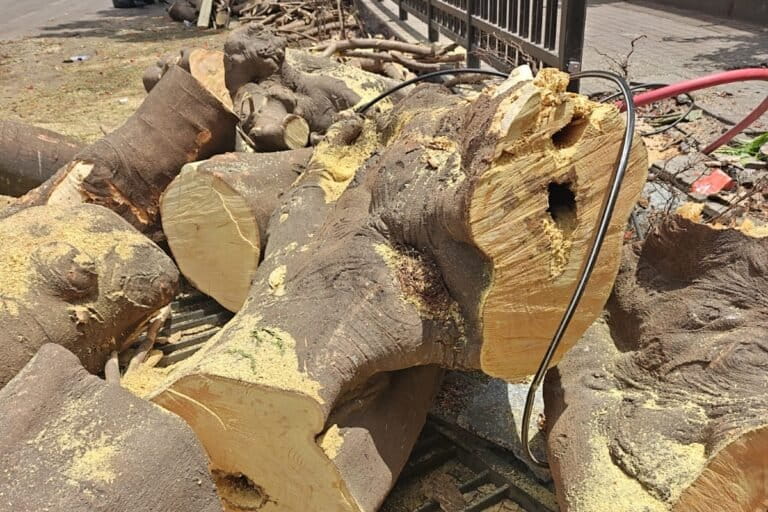
Every year before monsoon, pruning is done rampantly across Mumbai in an unscientific manner and without arboricultural principles. Officially, BMC does not have an arborist in the Tree Authority department.
However, Raje, an arborist, told Mongabay-India that he recently had some preliminary conversations with the BMC on tree assessment, statement of purpose (SOP) preparation and overall urban tree management.
Under the Maharashtra (Urban Areas) Protection and Preservation of Trees Act, 1975, only the Tree Authority of the BMC can permit cutting of trees. The BMC’s garden department handles permissions and rules for trimming or pruning of trees.
“Contractors are instructed to trim the tree from the top downwards so that it does not become top-heavy,” said Nilesh Baxi, an activist and former member of the Tree Authority. “If the centre of gravity shifts upwards, the tree can become vulnerable to falling during high-speed winds or heavy rain.”
Scientific pruning follows established arboriculture principles. As Raje explains, it uses smart techniques: selectively shortening branches to reduce canopy size and wind load; clearing lower branches to create space; removing dead or dying branches while protecting healthy growth; and guiding young trees while strengthening mature ones by fixing weak forks, codominant stems, and overextended limbs.
This year, most of the uprooted or fallen trees in Mumbai were mature.
“Older trees weakened by years of urban stress, such as soil compaction, pollution, and storm damage, are the product of accumulated neglect in managing both their canopy and root zones over the trees’ lifetime,” said Raje. He added that recent weather events can trigger even structurally sound trees with no prior stress or mismanagement. For this, he urged periodic structural risk assessment, covering canopy balance, as much as root health.
“Some species are more prone to root or branch failure in Mumbai’s soil and wind conditions, especially when planted in constrained pits with little room for root spread,” he explained.
Waterlogged soil, fungal decay, cavities or old pruning wounds that were never identified and properly managed are other factors for tree-fall incidents.
Tree officer and census
The 1975 Trees Act mandates that in every municipal area, the chief officer of the concerned municipal council shall be the Tree Officer, and the Council may appoint one or more of its other officers as Tree Officers. However, according to Baxi, there are vacancies for tree officer positions waiting to be filled, indicating a lack of staff in the department.
The Act also states that a tree census must be conducted every five years, but the last tree census in Mumbai was conducted in 2018. At the press conference, Bhide cited the 2018 census data, saying, “Mumbai has around 29.8 lakh trees, including nearly two lakh roadside trees.” After eight years, BMC is now conducting a tree census across the city.
BMC inquiry raises questions over accountability
Just 15 days after Vihaan’s death, BMC released its first inquiry report, where it self-investigated its officials and gave a clean chit to the road and garden department officials. Currently, three civic officials from the road, garden and tree departments are suspended.
The BMC held only the contractor and consultant, involved in nearby road-excavation work, responsible for failing to take adequate precautions, imposing a total penalty of ₹ 700,000. The full report was never made public, only a summary was shared.
Vihaan’s father, Gaurav Srivastava, and Mumbai Mayor Ritu Tawde both expressed dissatisfaction with the BMC’s internal inquiry, questioning its fairness. In response, a single-member independent committee was proposed in July, headed by former Mumbai University Vice Chancellor and botanist Sanjay V. Deshmukh and was asked to submit a report.
Gaurav does not doubt Deshmukh’s credentials, but remains apprehensive. “I am exploring legal options if required and seeking lawyers’ suggestions, whether to approach the court or wait for the second report,” he said. “This single-member committee has led us to seek opinions. But no decision has been made yet.”

The root cause
Umesh Mundlye, an environmental scientist, pointed out a core concern with the tree-fall incidents: civic apathy. “We treat trees merely as a resource for food, shelter, wood, but never as a finite source of equal dignity,” he said. “We don’t want to commit to something that doesn’t provide us with any monetary benefits. This holds true for citizens, as well as civic officials.”
As a psychologist, Reshma Ashar explained this as “extinction of experience” — a term originally coined by naturalist and writer Robert Michael Pyle in reference to the ongoing alienation of humans from the natural environment.
“People are living lives that make it difficult for them to notice trees,” said Ashar. “We cannot feel connected to something we rarely notice. But connection requires attention, and attention has become scarce in today’s time.”
Trees are believed to communicate through underground networks of mycorrhizal fungi connected to their roots. However, urban trees can experience loneliness.
Sayee Girdhari, senior project coordinator at SeasonWatch, said, “Just like humans, roots have their own preferences in choosing their neighbours or friends they can connect and exchange nutrients with. Unlike trees in a dense forest that live in interconnected, cooperative communities, trees on streets are often cut off from the social networks that help them survive and thrive.” .
Isolated trees cannot form the underground symbiotic networks that they need to receive nutrients, warnings and other benefits.
When Girdhari conducts tree walks in Mumbai, she is often met with one particular question: “How is this particular tree useful?” She emphasises the need to shift this anthropocentric mindset to an empathetic lens, and to see trees as fellow living beings.
Experts that Mongabay-India spoke to call out the notion that “trees are considered to be a hindrance in development”. They suggest urban space design and planning should be done centring the natural ecosystem to develop coexisting infrastructure.
Banner image: Concretising tree bases weakens them makes trees more vulnerable to falling during extreme weather events. A single week in July saw 902 trees being uprooted as rains fell. Image courtesy of Mumbai Citizen for Trees.
Read more: Cooling cities needs climate-smart design, not just more trees
Credits