- When El Niño is read as warming the ocean, fishers in Kerala, felt cooler seas at the coast than they remembered in earlier Julys.
- Kerala’s coastal cooling in the monsoon is a separate, local process, wind-driven upwelling, that operates independently of and can even run opposite to El Niño’s basin-wide warming.
- Fishers’ traditional knowledge is under strain as these overlapping patterns shift, but their firsthand observations remain an early, valuable signal worth taking seriously.
- The views in the commentary are that of the author.
The phone call came on a humid July afternoon. It was a fisherman from Marianad, a village in Thiruvananthapuram district where I first began my work with fishers in 1973. He was calling to share what he was seeing at sea.
The sea had been rough, he said. Fishers were still going out, despite the risk, because there were plenty of fish in the deeper waters. The turbid water was working in their favour too — fish were getting caught in the nets more easily. Supply on the shore was short, so prices were high. Earnings were good.
But something puzzled him. The sea felt cooler now than he remembered it in earlier Julys.
That was not what he expected. It was not what I expected either.
The name that came from fishers
To make sense of it, it helps to start with a story from the other side of the world.
Off the coast of Peru and Ecuador, fishers noticed that every few years, around Christmas, the ocean would turn unusually warm, and the fish they depended on would vanish. They named the phenomenon after the season it arrived in — El Niño or “the little boy,” referring to “the Christ Child”.
A name given by fishers has since become the scientific term for one of the most powerful climate patterns on Earth.
El Niño is not a local event. When the surface of the tropical Pacific warms, the effects ripple outward across the planet — shifting rainfall belts, weakening some wind systems, strengthening others. It is felt as far away as the coast of Kerala, even though the Pacific is thousands of kilometres from the Arabian Sea.

How El Niño reaches the monsoon
The Indian monsoon is driven, in simple terms, by the difference in temperature between land and sea. In summer, the Indian subcontinent heats up rapidly, and the air above it rises, creating a large low-pressure zone. The Indian Ocean stays relatively cool by comparison, so its air pressure stays higher. Wind flows from the high-pressure ocean toward the low-pressure land, carrying moisture with it. That inflow, broadly, is the monsoon.
El Niño can interfere with this system. When the Pacific warms, it shifts pressure patterns across the tropics in ways that often weaken the flow of moisture toward India, making the monsoon more erratic. This is a real and well-documented statistical relationship. But it is a tendency, not a rule. The Indian Ocean has its own warming and cooling cycle, known as the Indian Ocean Dipole, which can offset El Niño’s effect. Some El Niño years bring a poor monsoon to India; others, when the Indian Ocean itself is behaving favourably, bring a normal one. The relationship is real, but it does not always play out the same way twice.
What was actually cooling the sea off Marianad
My friend’s observation seemed to contradict what he had heard about El Niño: that it makes the sea warmer, not cooler. So why was he feeling cold water in July, in a year when the wider ocean was supposed to be running warm?
The answer lies closer to shore than El Niño itself.
Every year during the southwest monsoon, the coast of Kerala experiences its own, quite separate, cooling process, driven not by the Pacific but by the local wind. Along most of the Kerala coast, which runs roughly north to south, the monsoon wind blows parallel to the shore. That alongshore wind pushes the surface water out to sea, and cold, nutrient-rich water rises from below to take its place. Fisheries scientists call this upwelling, and it is one of the best-studied features of this coastline — it is also the reason the monsoon season here has traditionally been such a productive one for fishing, since the rising water carries the nutrients that feed the food chain.
This means that the wider Pacific and the sea off Marianad can genuinely be moving in opposite directions at the same time. El Niño can warm the ocean at a global scale, while the coast still cools locally because the monsoon winds, right there and then, do what they always do — push surface water out, allowing cold water to rise from below. One is a basin-wide pattern; the other is a narrow band of wind-driven cooling within a few dozen kilometres of the shore. Both are real. They are simply operating at different scales, and a fisher standing in the surf is only ever feeling the local one.

There is a further layer to this, specific to where Marianad sits. The coast stays roughly north-south past Thiruvananthapuram and Vizhinjam, and only bends toward an east-west orientation further south, from around the village of Enayam in Kanyakumari district onward to the Cape. South of that bend, the monsoon wind meets the shore almost head-on rather than alongside it, and the upwelling it produces is driven mainly by that direct, cross-shore push — the most intense upwelling found anywhere on this coast, concentrated in a narrow band near the Cape. North of Enayam, including all of the coast off Thiruvananthapuram district, the shore keeps its north–south line, and it is the alongshore wind that does the work, in the way just described.
Studies of this coast find that the alongshore upwelling is strongest in a band roughly between 8° and 10° north — and Marianad, at just under 8.6° north, sits comfortably inside that band, well north of where the coast bends. So the sea there was not simply undergoing the general cooling common to the whole Kerala coast in the monsoon; it lies close to the point where this particular kind of upwelling runs strongest.
The fish were following that cold, nutrient-rich water into deeper zones — easier to catch once you reached them, but harder and riskier to reach. And the high prices had a simpler explanation still: with the seas rough, fewer boats were willing to go out, so even with fish available, the catch reaching the shore stayed limited.
A coast built on upwelling
This intensity of upwelling has a longer history than any single El Niño year, and it may explain more than the temperature of the water. Studies of the shelf waters off southern Kerala have recorded over a hundred species of phytoplankton, fed both by upwelled water and by nutrients draining out from Kerala’s nearby backwaters — an unusually rich base for the food chain.
It is a plausible reading, though my own inference rather than something established in a published study, that this richness is connected to something fishers here already know without needing research to tell them: this stretch of coast has long supported an unusually wide range of species, and, in turn, an unusually wide range of gear and craft built up over generations to catch them — including boat seines of Portuguese origin, found in Thiruvananthapuram district and nowhere else on the Kerala coast.
The diversity of the catch and the diversity of the gear are both documented. Whether one produced the other is a connection worth stating carefully, as an inference, not as settled fact.

A new kind of reading
What my friend was experiencing is what fishers across Kerala are increasingly describing. The sea is not behaving the way it once did.
The signals passed down from earlier generations — the look of the clouds, the direction of the wind, the timing of the rains — are becoming less reliable guides. This does not mean the old knowledge was wrong. It means the conditions it was built to read are shifting under it. The winds, the rains, and the position of the fish are all adjusting to a warmer world, sometimes gradually, sometimes in short, sharp departures from the pattern of a lifetime.
El Niño is a natural phenomenon. It has always existed, and Peruvian and Ecuadorian fishers were describing it centuries before oceanographers gave it a formal place in climate science. What is different now is the backdrop against which it plays out: warmer oceans, a more erratic monsoon, and coastal ecosystems already under pressure from other directions.
For fishers on Kerala’s coast, this adds up to a harder task — not just going out to sea, but working out, season by season, which parts of their inherited knowledge still hold and which need to be revised in light of what they are seeing with their own eyes.
The call from Marianad was a reminder of something worth taking seriously: fishers are usually the first to notice these shifts, long before they show up in a dataset. They are not just living through the changes in these waters. They are, in their own way, still reading them — and it is worth listening closely to what they are finding.
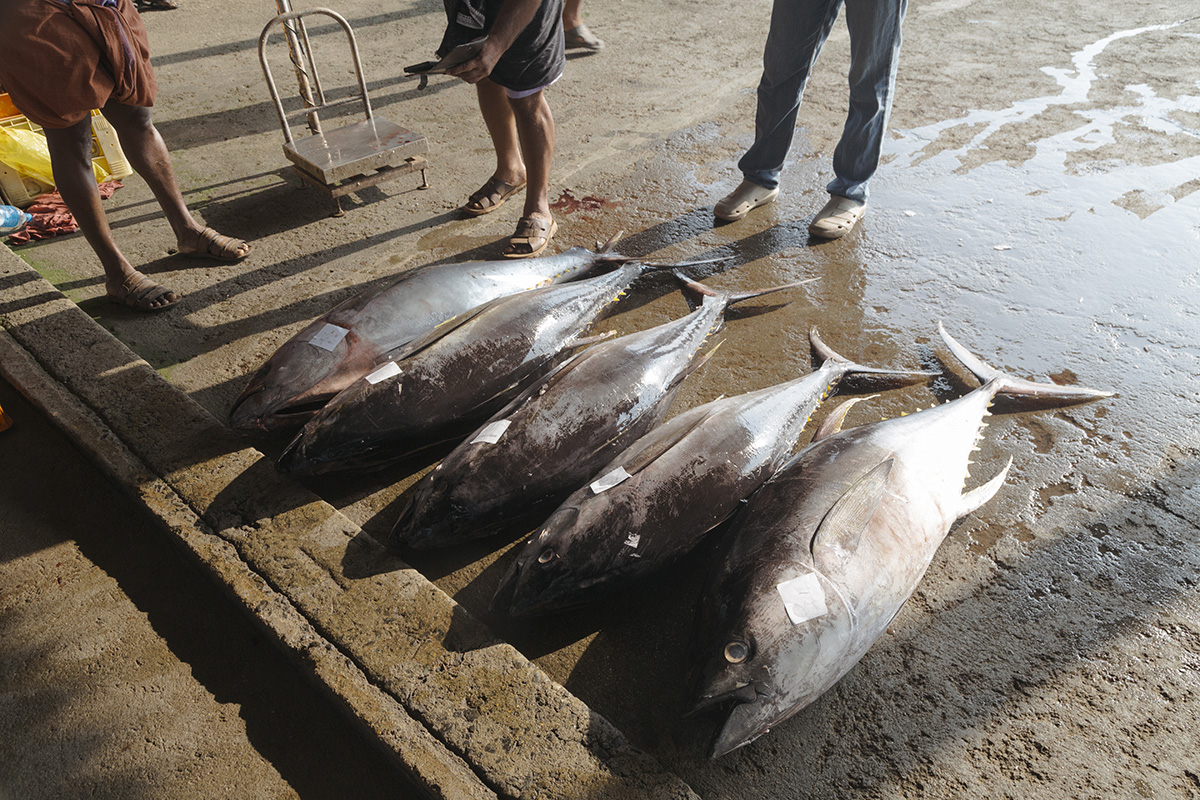
Banner image: Fishermen at work in Kochi, Kerala. Image by Vyacheslav Argenberg via Wikimedia Commons (CC BY 4.0).
The author is a development practitioner, who has worked with small-scale fishers in Kerala, India and other Asian countries for five decades. He was also professor at the Centre for Development Studies (CDS), Thiruvananthapuram.
Read more: El Niño forecast increases likelihood of weak monsoon and water stress
Credits