- A study documenting manta and devil ray landings across a decade in a coastal area in Tamil Nadu reveals declining populations and fewer adult rays.
- The proportion of adult spinetail devil rays in marine species brought to shore fell from 64% to 26% over the study period. With rays producing just one pup every two to three years, the loss of breeding adults makes population recovery more difficult.
- Though all 10 species of manta and devil rays were listed under CITES Appendix I in November 2025, prohibiting commercial international trade, the restrictions do not cover domestic catches and trade.
Manta and devil rays, collectively known as mobulids, are large cartilaginous fish known for their broad, wing-like pectoral fins, which help them glide through the water. They often feed on zooplankton and small crustaceans and fish in shallow coastal waters, making them vulnerable to entanglement in fishing nets.
Roughly 259,000 mobulids are killed each year in fisheries, globally. Five countries — India, Indonesia, Sri Lanka, Myanmar and Peru — account for 87% of these deaths, which are mostly attributed to small-scale fisheries. India is the highest contributor, accounting for 28.2% deaths.
Limited catch data and inadequate understanding of the impacts of small-scale fisheries make it difficult to assess the status of these species. Increasing fishing pressure puts several ray species at risk of population collapse.
To address this gap, a group of researchers tracked mobulid bycatch from fishing boats in Thoothukudi, Tamil Nadu, between 2013 and 2023. Their study, published in Conservation Science and Practice, found evidence of declining populations of four species — the spinetail devil ray (Mobula mobular), the sicklefin devil ray (Mobula tarapacana), the oceanic manta ray (Mobula birostris), and the bentfin devil ray (Mobula thurstoni). The study notes that these population declines occurred alongside increasing fishing pressure, suggesting overfishing as the likely cause.
“Counting the number of mobula rays caught is always confusing,” said Divya Karnad, a senior lecturer at the University of Exeter and an author of the study. Because the research team wanted to track real changes in the population, they divided the catch by fishing effort, which covers both the number of vessels and how efficient their gear is. “We then looked at trends using this standardised value to distinguish a real increase or decrease in population from an increase or decrease due to changes in effort,” she added.

What the study found
The study focused on two landing sites in Thoothukudi district — Threspuram and Tharuvaikulam. Data was collected in two time periods, 2012–2014 and 2023. Across the study period, a total of 8,163 mobulid landings of six species and a few unidentified species were recorded. Of these, the spinetail devil ray was the most common, accounting for up to 86% of the mobulid bycatch. In 2013, the most mobulid landings were observed from May to July, while in 2023, most occurred from July to September, coinciding with the peak tuna fishing season.
The researchers examined three different measures to compare changes in the mobulid populations between 2013 and 2023 — the mean disc width (the length from one end of the pectoral fin to the other), the ratio of adults to juveniles, and landings per active vessel.
The mean disc width of landed individuals was measured to examine the changes in the population structure of rays. They found that the mean disc width of spinetail devil rays decreased by 10 centimetres over the decade. The researchers suggest that this change was not necessarily because the adults were becoming smaller, but because fewer adults were in the populations. Such population-level changes can be useful indicators in data-limited fisheries where age- or stage-specific data are unavailable. The researchers acknowledge that because spinetail devil rays are long-lived and reproduce slowly, 10 years is likely too short to detect evolutionary changes in body size.
Researchers also observed fewer adult spinetail devil rays among the landings over the study period. The results show that the proportion of adults has fallen from 64% to 26%. This raises concerns about population stability, given that adults have shown greater reproductive output, which is essential in fluctuating or perturbed environments.
Older individuals are economically valuable, as they have larger gill plates, and are therefore vulnerable to overharvesting. For rays, which produce just one pup every two to three years, a decline in adult numbers puts the species at increased risk.
“The age-class truncated population [higher juvenile-to-adult proportions] of spinetail devil rays leaves fewer viable recovery pathways, making recovery more challenging,” says Mayuri Chopra, research scholar at Oxford University, who is the lead author of the study.

More boats, fewer rays
During the study period, the team also found that at Threspuram, landings of spinetail devil ray per vessel fell by 86%, sicklefin devil rays by 92% and manta rays by 83%. Bentfin devil ray landings showed no decline at Threspuram, but catch dipped by 65% at Tharuvaikulam.
Yet, total ray landings increased by 4% in the same period.
Researchers attribute this contradiction in catch to an increase in fleet size and a shift towards more technologically advanced fishing operations that can travel farther and fish more efficiently.
“More efficient technology or more boats will get a higher catch, but that does not mean that there are more fish in the sea,” says Karnad.
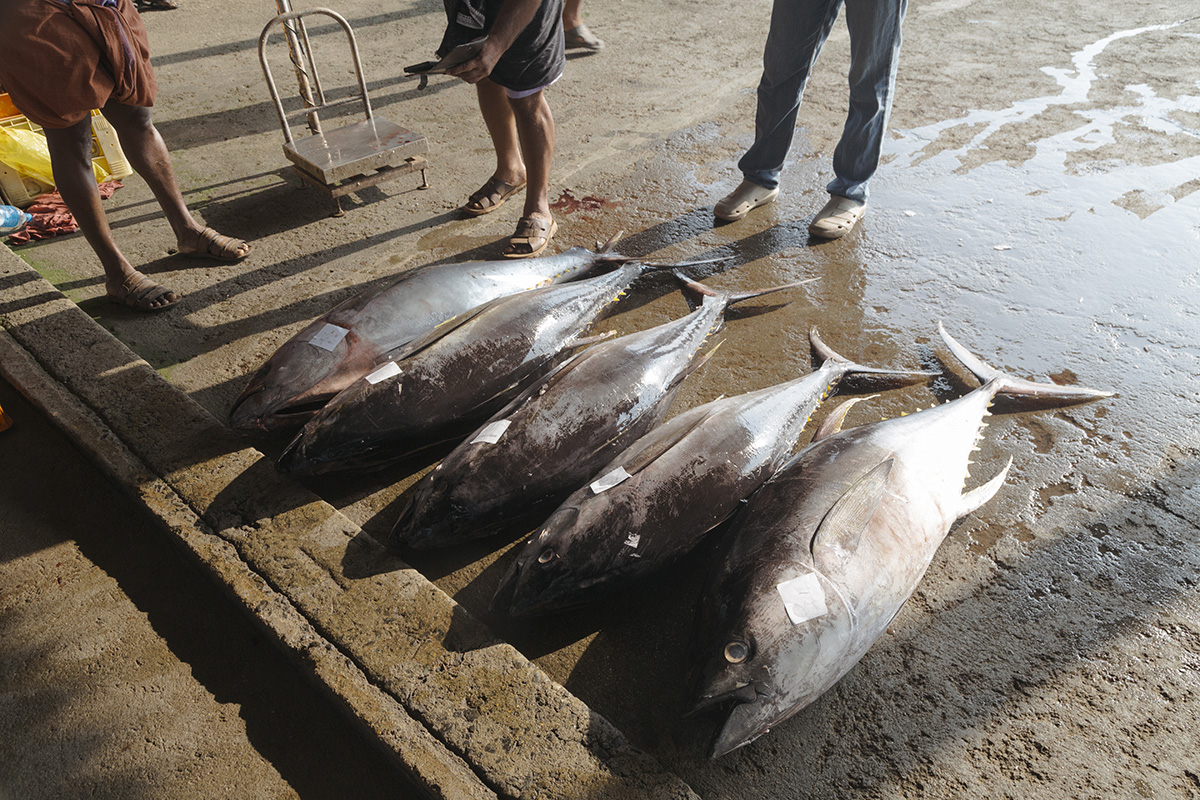
Researchers found that drift gill nets — the gear characteristic of small-scale fisheries in Thoothukudi — accounted for 98.9% of all mobulid landings. Fisheries targeting tuna alone accounted for 50.2% of total mobulid bycatch, while gear used in other semi-selective fisheries contributed a further 46.2% of the mobulid bycatch recorded in 2023.
Small-scale fisheries, big impacts
Small-scale fishing is often considered a more sustainable alternative to industrial fishing.
However, a 2025 study found that more than 75% of coastal elasmobranchs — sharks, rays and guitarfishes — are threatened with extinction globally due to small-scale fisheries. Operating within a few kilometres of the coast, these fisheries often overlap with critical shark and ray habitats.
For many small-scale fisheries, including those in India, the problem is compounded by limited catch and fishing-effort data. Conventional stock assessments generally require long-term information on species-level catch, fishing effort or changes in body size. When such information is missing, declines can go unnoticed.
Given the scale of its small-scale fisheries and its place among the world’s top five mobulid traders, experts note that India has an important role to play in charting a safer future for these species. While some steps have been taken in that direction, policies often overlook the biology and life histories of species.

Misaligned biology and policy
According to India’s Wildlife (Protection) Act, 1972, manta and devil rays are given different levels of protection. Since April 2023, manta rays have held Schedule I status — the highest level of protection that prohibits hunting, poaching, or trading. But devil ray species, which face similar fishing pressure and have equally slow reproductive rates, have weaker protection. The sicklefin devil ray is listed under Schedule II, while the remaining four devil ray species, including the heavily fished spinetail devil ray, fall under Schedule IV, a category for species listed under the Convention on International Trade in Endangered Species of Wild Fauna and Flora (CITES) appendices, meant to regulate their international trade and possession in India.
This mismatch is not unique to rays. India’s fisheries policies have often overlooked the species-specific biology and life histories that determine how vulnerable species are to fishing pressure. A 2023 study in Marine Policy found that the annual fishing bans on the west coast overlap with the breeding periods of fewer than 40% of commercially fished species.
Over the past two decades, demand for dried mobulid gill plates, sold in Asia as traditional medicine, has driven targeted fishing and increased incidental catches of manta rays. Globally, mobulids are consumed in at least 35 countries, with gill plates harvested in 14 countries, including India, and traded mainly to China and Hong Kong.
In November 2025, all 10 manta and devil ray species were added to CITES Appendix I, prohibiting commercial international trade of the animals and derived products. However, this does not address what happens to mobulids caught and traded within national borders.
“All devil rays continue to decline. This suggests that current conservation measures are not working and CITES has been ineffective in improving their status because it only regulates international trade; it has no control over domestic catches or trade, and enforcement and monitoring are lacking,” says Peter Kyne, fish biologist and adjunct senior research fellow, Charles Darwin University, Australia.
Currently, there is no compensation for fishers to release rays caught as bycatch, so incidental captures are sold in local markets for consumption.
Chopra and team caution that with export markets closed, mobulids may be redirected toward local consumption, a dynamic that wouldn’t show up in trade statistics but could sustain fishing pressure.

Protecting rays by reducing fisheries pressure
How ray species are impacted within country borders depends on domestic fisheries policies and local compliance with protection measures.
The researchers suggest that understanding which vessel and gear characteristics contribute most to mobulid bycatch is important for developing effective fisheries management measures at the state level. They propose that reducing mobulid bycatch could involve measures such as shortening the time nets remain in the water and making mesh sizes smaller, though they caution that this may have unintended consequences for other species and that these measures need to be evaluated for effectiveness.
Gear changes alone may not be enough. The researchers argue that devil rays, like manta rays, should receive strict no-take protection under Indian wildlife law. Protecting important habitats used by rays at different life stages and regularly monitoring populations would also be essential.
“Population recovery of mobula rays will be on a timescale of decades rather than years,” says Karnad. “We have seen smalltooth sawfish show significant recovery in the U.S. within two decades with strict conservation measures.”
Banner image: A spintail devil ray. Representative image by Julien Renoult via Wikimedia Commons (CC BY 4.0).
Read more: Study explores social media as a tool to track shark and ray consumption
Credits