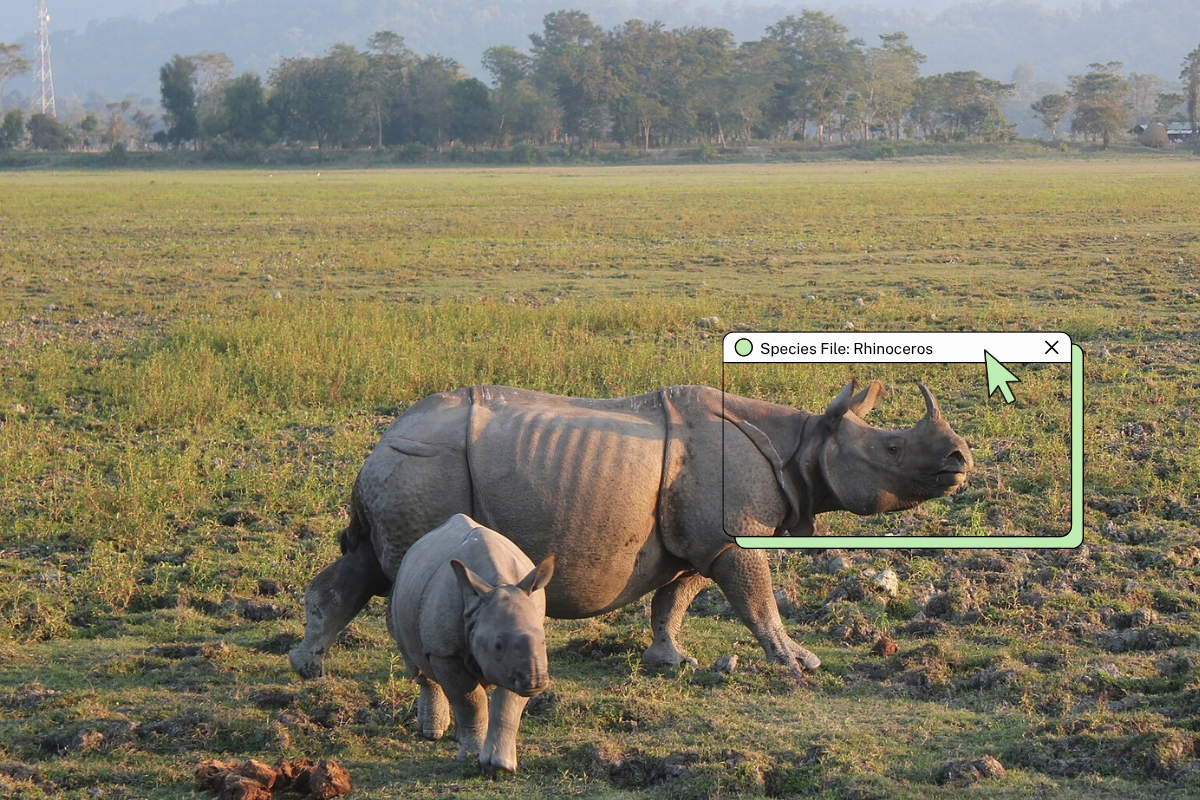
Conservation efforts have re-established the greater one-horned rhinoceros in Assam’s Manas National Park. The species had once been wiped out from the park but was brought back through wild-to-wild translocation and rhino rehabilitation programmes. A recent study of the re-established population offers encouraging signs of adaptation in its restored habitat.
The greater one-horned rhino (Rhinoceros unicornis) is the largest of the three rhino species found in Asia. It is identified by a single black horn, about 8-25 inches long, and grey-brown hide with skin folds that give it an armour-plated appearance. It’s about half the weight of an elephant, going up to 2,700 kilograms and is around 6.5 feet tall.
Despite its size, the rhino is a good swimmer and spends considerable time in wetlands and grasslands. It mainly feeds on grasses, leaves, branches of shrubs and trees, fruit, and aquatic plants. The greater one-horned rhino now numbers at around 4,075 individuals found only in the grasslands of India and Nepal.
The IUCN Red List classifies the species as vulnerable, which means it faces a high risk of extinction in the wild. In India, it receives the highest legal protection under Schedule I of the Wildlife (Protection) Act, 1972, and is listed in Appendix I of CITES, which bans international trade.
Rhinos play an important role in shaping grassland and wetland ecosystems. However, habitat loss and fragmentation, invasive species and human-animal conflict remain major threats to the species. The rhino has also faced illegal hunting for its horns.
In a story published by Mongabay-India in April 2026, Mudit Gupta, Landscape Lead, Eastern Terai, Terai Arc Landscape, WWF-India, said, “Poaching remains a potential threat once rhinos are outside fenced protection, and it is countered by increased ground patrols, intelligence-led protection initiatives, ongoing radiotelemetry tracking of released rhinos, and close cooperation with enforcement agencies across borders.”
Read more about saving India’s wild ‘unicorns’ and what the DNA says about the future of rhinos in India.
Banner image: One-horned rhino with baby in Kaziranga National Park, Assam. Image by Joli via Wikimedia Commons (CC BY-SA 4.0).