- Artists are using public spaces to highlight the impact of climate change on communities and their livelihoods.
- They experiment in different formats such as comic strips, photographs, multimedia, theatre, art installations and more to humanise climate change and turn data into lived experiences for the audiences to understand easier.
- Climate change-induced displacement, dams and local ecology, oceans and carbon sequestration and climate-resilient food systems are some of the themes tackled by artists and festival or exhibition curators in India.
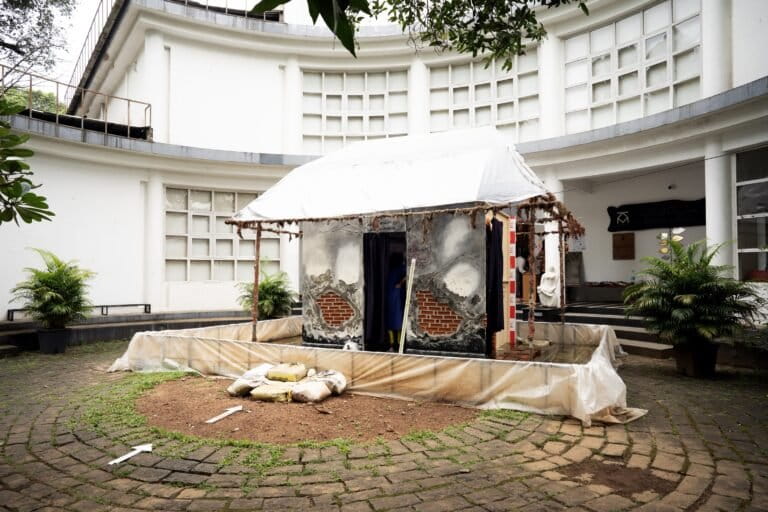
In Kerala’s coastal villages, thousands of families have endured the chronic onslaughts of tidal flooding. While it is possible to learn about this news, how can one experience the lived realities of these families or understand their remarkable resilience? This question led visual artist and educator Radha Gomaty to create an experiential installation, Water as Mirror, which replicated the actualities of families living in homes with saline water for months during the inundation.
Just as the many homes in these affected coastal villages, the 8 feet x 10 feet one-room installation was inundated with saline water. The walls, weathered by the burden of overt dampness and seawater salinity, were peeling off. A tidal calendar hung precariously above a metal rack stacked with essentials, while an old wall clock was coated in grime. Amidst the chaos, a mirror stood tall, inviting people in to look at themselves and imagine themselves there in the unimaginable pain.
Water as Mirror was part of the recently concluded exhibition KaBhumM!!! in Kochi’s Kerala Museum. Its curation aimed to spotlight the impact of tidal flooding on the livelihoods and everyday lives of coastal communities. “Kerala’s coasts are no longer on the brink of a disaster. They are already slipping into it. The ignorance runs so deep that even local visitors were unaware that just a few kilometres away, homes were submerged,” says Gomaty.
Artists like Gomaty are transforming abstract data into lived experiences, and are reshaping how people understand and feel the impacts of climate change, through their work. “KaBhumM!!! has been about awakening the consciousness of people in a very gentle way. Art has the power to do this without being loud, harsh or preachy,” says Gomaty, who also curated the exhibition.

Exploring climate conversations through a creative lens
KaBhumM!!! is one among a growing number of initiatives where art is driving climate change conversations. For centuries, art has been celebrated for its innate ability to connect with people at a visceral level. From political issues to social justice, art in its myriad forms has provoked and engaged meaningfully with a larger audience. In recent years, artists have trained their lens on environmental issues and employed a creative approach to make complex realities more relatable and humane.
For instance, Danish-Icelandic artist Olafur Eliasson’s famous 2014 public project Ice Watch, used ice blocks which were placed in public areas where they were left to melt, to inspire action against climate change. The project has travelled to Copenhagen, London and Paris. In 2018, a professor and climate scientist Ed Hawkins created the famous Climate Stripes — a series of vertical-coloured bars — a visual representation of global average temperature over nearly two centuries. Since 2015, the world’s first Climate Museum in New York has been helping the audience decode complex climate issues through interactive workshops, talks and community activities.
In India, artistic practices of independent artists such as Ravi Agarwal and Vibha Galhotra have intertwined themes of ecology and environmental concerns. While Agarwal explores themes of environmental justice, ecology and environment through a socio-political lens, Galhotra uses multimedia to highlight the social, economic and political implications of human activity on the environment.
Several homegrown documentary filmmakers have explored individual actions and climate injustices through visual media. A collaborative partnership between Early Bird and the Indian Music Experience Museum, resulted in Birdsong, an exhibition which spotlighted the contribution of birds to our ecological and cultural wealth. Greenpeace India’s Museum of Memories has brought forth human stories of people affected by heat waves through material culture.

Compelling storytelling
There has been a greater disconnect in effectively communicating complex scientific information to non-experts, resulting in a significant gap in understanding the urgency of climate change and its impact on communities. “We have to move beyond averages and numbers, and bring forward lived experiences of those devastated by climate change,” says Sreeja K.G., the Research Director at Equinoct, a Kerala-based climate-tech startup, which works with coastal communities to provide science-based solutions. That is why the startup decided to employ the format of community theatre to reach the climate message. In 2023, the idea of the play Chevittorma was born when Equinoct collaborated with director Sreejith Ramanan. Chevittorma is a colloquial expression which means “to whisper last words into the ears of the dying”.
But the real magic unfolded when victims of tidal flooding from the village of Puthenvelikkara were roped in to re-enact their lived experiences on the stage in ankle-deep water. “The play has been a huge success. Even for these community actors who somehow have lost a lot, they have reclaimed their dignity on the stage,” says Sreeja, adding that it has travelled to Delhi, Mumbai and was recently staged at KaBhumM!!!
While community-led performances like Chevittorma root climate conversation in lived experience, national institutions are finding creative ways to make climate science accessible and relatable.
In 2020–21, the Council on Energy, Environment and Water (CEEW) realised that data and policy alone wouldn’t move the needle. To drive real change, it needed to engage the public. When India announced 2070 as its net-zero target at COP26, the Delhi-based think-tank noticed a sudden shift in public perception. “It was a pivotal moment. People sensed the world was changing. They wanted to learn, but didn’t know where to start. It was around the same time we were contemplating how to make climate part of dinner table conversations,” Mihir Shah, Director — Strategic Communications, CEEW, tells Mongabay-India in a video interview.
This need to humanise climate change led to the creation of the bi-weekly cartoon strip What on Earth! and the short documentary series Faces of Climate Resilience, featuring 16 stories of collective strength and individual action from India’s five most climate-vulnerable states. In 2023, CEEW collaborated with artist duo Thukral and Tagra to launch the climate-art exhibition ‘Sustaina India’, spotlighting material-based practices, community initiatives and sustainable innovations. The cartoon strip and the exhibition have now become a staple on CEEW’s cultural calendar. What on Earth! is posted on CEWW’s social media platforms regularly.
“Our identities are shaped by pop culture. You can’t interpret a number in many ways, but a creative work can spark endless interpretations,” says Shah, adding that the comic strip will be showcased at the upcoming Jaipur Literature Festival.
When art fosters empathy in climate change conversations
Visual narratives are perhaps one of the most effective ways to grab the attention of people who are consumed by information overload. But how one chooses to tell these stories makes all the difference. “Climate change hasn’t become an everyday conversation like, say, plastic pollution because we haven’t been able to decide from whose perspective we are even seeing it. How do communities and everyday lives fit into the narrative? These are questions we need to confront if climate discussions are to resonate with a wider audience,” says Agarwal, who is one of India’s foremost environmental artists and activists.
This is the reason why Agarwal, whose artistic practice sits at the intersection of climate justice and ecology, is always drawn to artists whose works emerge from lived experiences rather than abstract ideas. He highlights the works of visual artists Zishaan Latif and Kunga Tashi Lepcha, whose works will be showcased at the upcoming edition of the multidisciplinary festival, Serendipity Arts Festival (SAF) in Goa in December. While the Latif’s photographic work examines the impact of climate-induced displacement and identity crisis amongst Assam’s Miya community, the Lepcha’s multimedia project highlights how Sikkim’s serenity is ravaged by the construction of dams, triggering a shift in local ecology and cultural identity.
What happens when climate change conversations become part of a public arts festival? “It has the power to create a significant impact,” says Smriti Rajgarhia, Director, Serendipity Arts Festival. In the last few years, the festival has integrated climate concerns into its culinary and visual arts disciplines. “Given the scale of our audience, we feel a strong responsibility in how we communicate climate change. Using culture to share information that many festival-goers may not otherwise access makes us proud, but we are also mindful of how we bring that conversation to the public,” she adds, adding that the festival attracts around 500,000 visitors across diverse age groups and regions.
In its previous editions, SAF has made climate conversations relevant by exploring climate-resilient food systems to connect environment and time, and highlighting the role of oceans in carbon sequestration, and inviting the audience to engage with local fishing communities. “Public art flips the usual power dynamics. Beyond what policies and governments do, art has its own contribution to make,” says Agarwal who also curates the environment-focused visual arts section of SAF. “It is about humanising the data and connecting climate stories with local narratives.”
Read more: When art meets environment: In conversation with Labonie Roy [Interview]
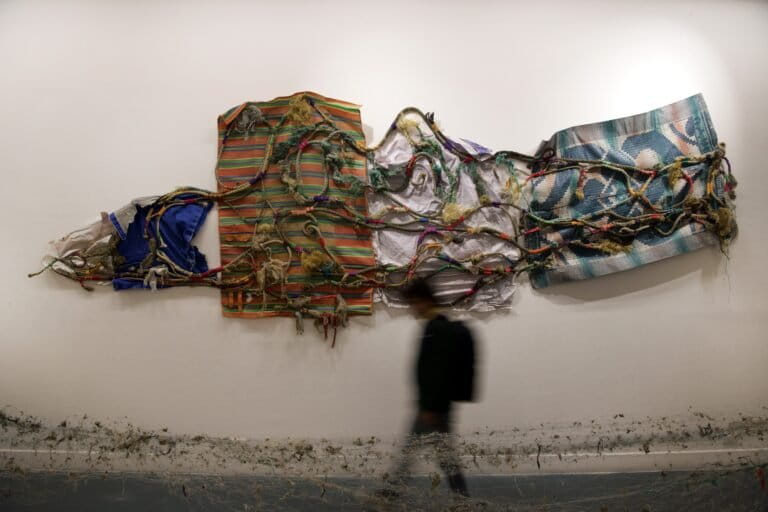
Banner image: An artwork curated as part of Time as a Mother by Damian Christinger and Ravi Agarwal for Serendipity Arts Festival 2023. Ravi’s curatorial approach explores the intersections of art, ecology, and climate change. Image by Philippe Calia and Sunil Thakkar/Serendipity Arts Festival.
Credits