- In May 2020, Oil India Limited’s oil field in Assam’s Baghjan experienced a leak resulting in a blowout that displaced thousands and had widespread environmental impacts.
- Our Burden of Grief, a recent book co-authored by Sanjay Barbora, Dolly Kikon and Noihrit Gogoi, captures the tragedy through the voices of those impacted.
- The book includes data from a health survey conducted by the authors in which Baghjan residents reported physical and mental health impacts post the blowout. The authors call for detailed research to understand the real health impacts.
“…Neither a fleeting joy,
nor an unbidden laughter remains.
In a moment,
OIL took it all,
stripping me of everything.”
This stanza is from a poem written by Papul Gogoi, a resident of Baghjan, Assam, from the point of view of a (fictional) woman who lost everything in the Baghjan blowout, a 2020 industrial disaster that had widespread impacts on people and the environment. The poem, expressing grief and despair about the blowout, is part of a book Our Burden of Grief published in October 2025.
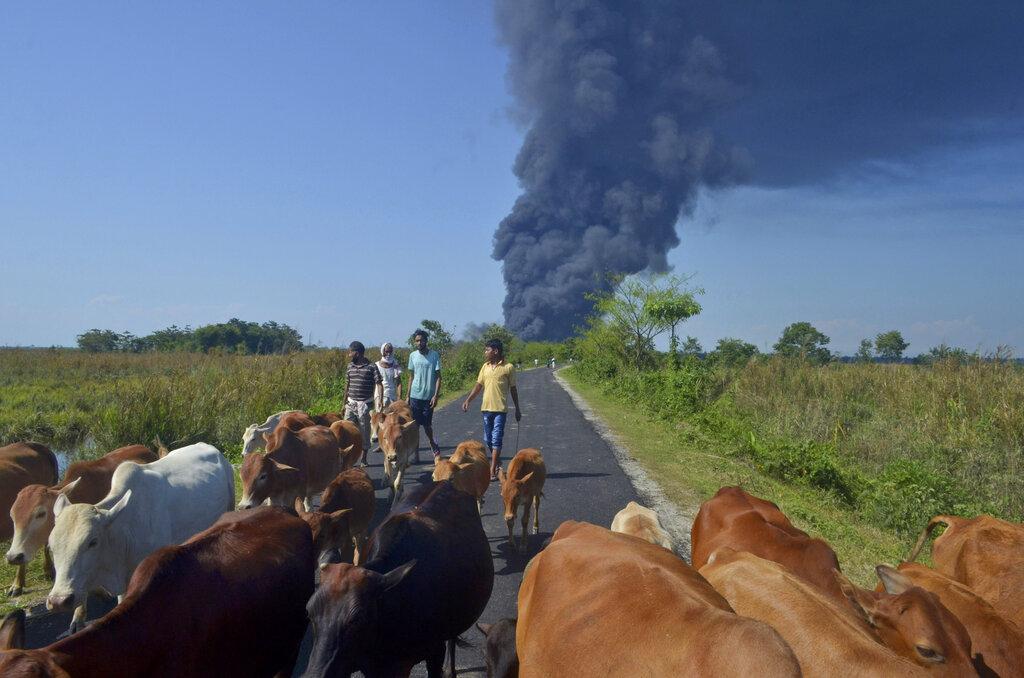
On May 27, 2020, there was a leak in Oil India Limited’s (OIL) Well No. 5 in Baghjan Oil Field, Tinsukia, Assam, resulting in the uncontrollable flow of the natural gas (methane gas), crude oil and condensate droplets. People living nearby had to be evacuated. A subsequent blast on June 9, 2020, completely burned down 12 houses and more than 10,000 residents from nearly a dozen villages within a three-kilometre radius of the rig were affected and displaced. The fire engulfed adjacent wetlands, killing endangered birds and animals. The fire lasted for almost six months, and OIL only succeeded in extinguishing it entirely on November 15, 2020.
The impact of the incident, one of the worst industrial disasters in modern India, has been captured in the book Our Burden of Grief. The book, co-authored by Sanjay Barbora, who teaches sociology and social anthropology, and Dolly Kikon, who teaches anthropology, both at the University of California, along with Noihrit Gogoi, a PhD student in sociology at the same university, was published by North Eastern Social Research Centre (NESRC), supported by a grant from Swedish Research Council.
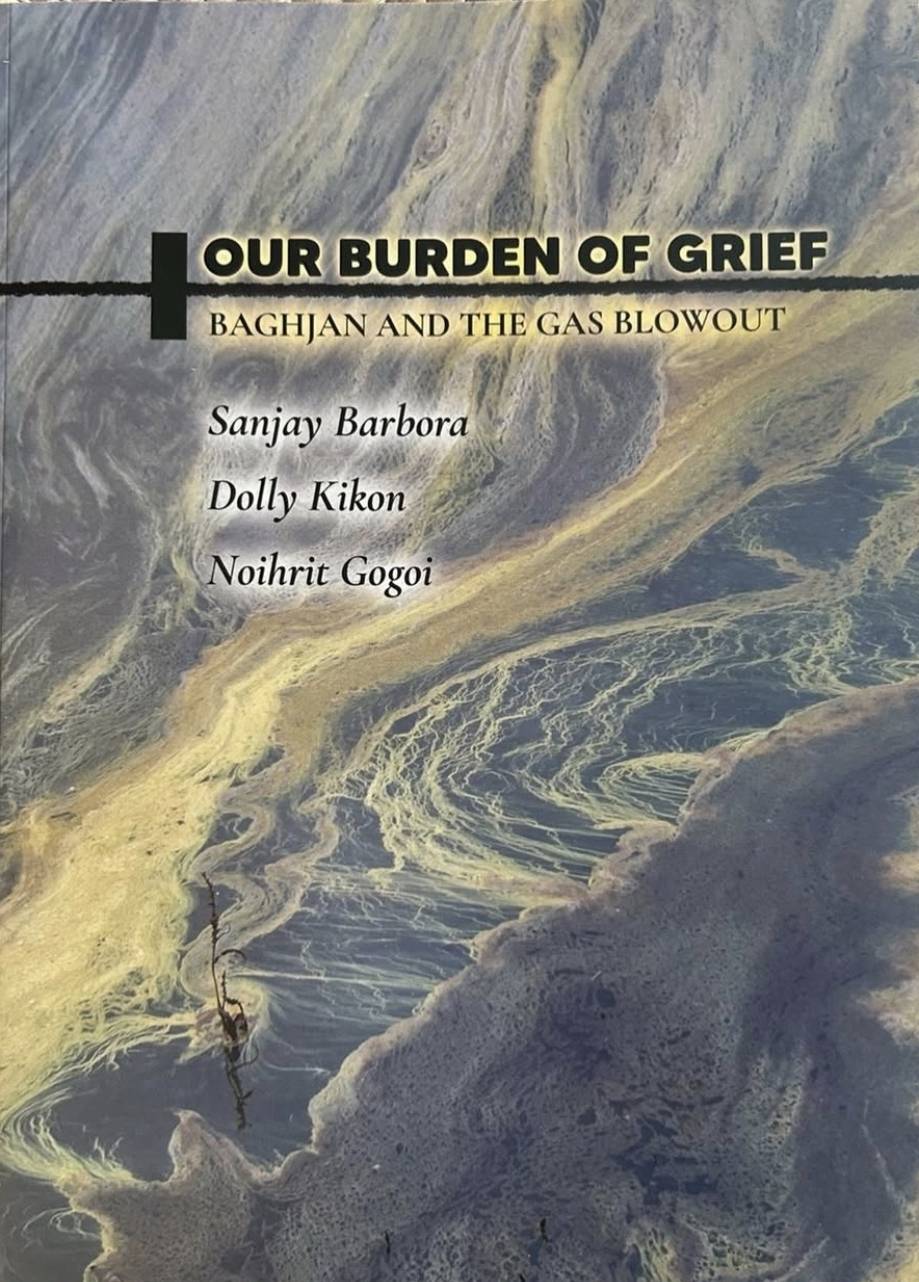
Publisher: North Eastern Social Research Centre
Print length: 236 pages
Publication: September 17, 2025
Genre: Nonfiction
Our Burden of Grief examines the impacts of the Baghjan gas blowout on May 27 2020 in Tinsukia, Assam which resulted in an uncontrollable leak of natural gas and crude oil, and burned down 12 houses and affected 10,000 people. It draws from the experiences of survivors, media reports, official inquiries, and interviews.
In the foreword, Walter Fernandes the director of NESRC says, “The book brings together the reactions of people who attempt to understand the dilemma and become the voice of the people of Baghjan who became voiceless victims of a disaster.”
“While the idea for the book emerged in December 2022, the book itself draws on my engagement with Baghjan since 2020,” Barbora told Mongabay-India.
Adapting to new realities
“The fire kept raging for months,” said Monoj Hazarika, a local who said there was not enough public outrage about the incident. When locals staged a protest against the incident on July 24, 2020, there were clashes between the people and the police. Hazarika added that the community was not opposed to OIL. “What upset us was the callousness and disrespect they showed when this fragile landscape was destroyed.”
He also added that the presence of OIL is not benefitting the locals in terms of livelihood either. “In the last 17 years, only four men from the village had found employment as subcontractors and menial workers with OIL.” He said, “People from the area should have some moral and ethical claims to jobs with OIL, since all the extraction was happening on their land.”
Baghjan residents pointed out that their livelihoods instead were closely connected to nature and now, with the environment damaged by the oil leaks, they need to adapt to a new reality.
Niranta Gohain from the village Notun Rangagora, located about two kilometres away from the Baghjan blowout site, pointed out how the affected families were denied compensation. “The company spent more than ₹400 crores (₹4 billion) to avoid bad publicity, but they spent only ₹80-90 crores (₹800-900 million) on compensation. OIL had paid around ₹25 lakhs (₹250,000) to 12 severely affected families. The remaining 612 families received a paltry sum of ₹10-15 lakhs (₹1-1.5 million). Initially they paid ₹30,000 for each family in Baghjan and ₹25,000 for families from Notun Rangagora and for the people who were living in deplorable conditions in the relief camps, it was decided that they would get ₹50,000 to find rental accommodation elsewhere. However, they paid only a single instalment, and as soon as the fire was doused, OIL stopped the payments altogether, saying that these families don’t deserve compensation,” Gohain stated in Our Burden of Grief.
Analysing health impacts
The health survey conducted in Baghjan in 2023, a few years after the blowout, emphasised the importance of focusing on health, especially mental health in the aftermath of the Baghjan blowout.
The volunteers visited a total of 545 households and filled out questionnaires prepared specifically for the survey with help from medical practitioners and a clinical psychologist.
The survey by Foundation for Social Transformation (FST) recorded people as saying that the blowout led to contamination of their drinking water. Water has changed in both smell and substance, with a pungent odour and a dark colour. The residents complained of headache, cold, fever, skin rashes and others. More than 300 residents complained of regularly suffering from sore throats and blocked, sniffed nose or sneezing fits. More than 600 residents complained of frequent tiredness and around 800 reported that they suffer from some form of headache. People also complained about problems with vision, tired or irritated eyes, and difficulty in hearing. Women from the community also complained of issues related to pregnancy, menstrual cycle and hormonal imbalance.
Respondents also spoke about anxiety and other mental health issues. Some reported having become restless, impatient and helpless. The survey found the presence of negative changes in mood and thinking. They reported developing anger issues and becoming irritable and reluctant to perform any activity involving risks.
Speaking to Mongabay-India about the health crisis in the area, Noihrit Gogoi said, “People have reported a significant rise in cancer cases, along with an increase in skin-related illnesses. Psychological distress and mental health issues have also been widely reported. While I am not medically qualified to make definitive claims about their causes, the very fact that these claims are being made repeatedly and consistently demands serious attention.”
While the health problems are not yet medically established as linked to the blowout, anecdotal evidence shows a high number of health issues across the residents of the affected area.
Barbora meanwhile said that to know the real health impact of the Baghjan blowout, long-term research is required. “We will need help from the medical community to conduct that kind of research,” he said.
Initiating a dialogue
Talking about her experience with the project, co-author Dolly Kikon, told Mongabay-India, “The key takeaway for me is to document community experiences and voices on the ground. There are ongoing issues of contamination, compensation, and legal matters, but the key takeaway of this book is to situate engagement, advocacy, and research.”
“My co-authors and I wrote this book in the hope of initiating a dialogue, one that we feel has been somewhat absent or insufficient despite the magnitude of the disaster,” Noihrit Gogoi added.
Read more: Three years after an oil well blowout, this Assam wetland is slowly coping
Banner image: National Disaster Response Force personnel conduct a rescue operation at the site of the explosion at Baghjan, Tinsukia district, Assam on June 10, 2020. (AP Photo/Partha Sarathi Das)
Credits