- In mammals, colour depends on a pigment called melanin, and genetic changes that affect how it is produced can lead to colour aberrations.
- Over a century, between 1886 and 2017, 239 cases of colour aberrations have been recorded in 56 of the 420 mammalian species in India.
- Animals affected by colour aberration can have a wide range of impacts, from severe physiological impairments to minimal changes in their daily survival.
On the morning of January 3, 2026, wildlife biologist Sanjay Gubbi posted on social media that an “ultra-rare” leopard colour morph had been recorded in Karnataka’s Vijayanagara district for the first time.
The camera trap image obtained by Gubbi and his team at the Holématthi Nature Foundation (HNF) showed an Indian leopard (Panthera pardus fusca) — a female estimated to be six to seven years old — sporting a pale reddish-pink coat and light-brown rosettes, unlike the typical tawny coat and black rosettes. In a statement by HNF, Gubbi shared that the recorded individual is consistent with erythrism or hypomelanism, “a genetic condition involving either an excess of red pigmentation or a deficiency of dark pigmentation”.
“To give the colour morph a native identity and reflect Karnataka’s cultural heritage, we have named it the sandalwood leopard,” Gubbi wrote in a post explaining the rationale for naming the colour morph after the Karnataka state tree.
Internationally, such leopards are known as strawberry leopards, and there have been a handful of records from South Africa and Tanzania before. But, until now, only one such individual has been reported from India, in Ranakpur, Rajasthan.
This begs the question: What are colour morphs, why do they occur, and how do they impact animals?

How does an animal get its colour?
Be it the black and white stripes of a zebra, the rosettes of a leopard, or the orangish hair of an orangutan — coat colours and patterns are one of the most identifiable traits in mammals. At the same time, the colour or pattern of colours on a mammal plays a crucial role in concealment or camouflage, communication, and physiological processes such as thermoregulation and UV protection (most famously in human skin).
An animal’s colour depends on the pattern of a pigment called melanin and its regulation. “Melanin is a key pigment in humans and the rest of the mammals, as well as the animal world,” Rajgopal N. Patil from the Institute of Natural History Education and Research, Pune, told Mongabay-India via email. “When the body produces less or more than the normal amount [of melanin], it can result in an aberrant individual with a lighter or darker colouration.”
Abnormal melanin production happens because of genetic mutations that impact pigmentation, causing colouration that deviates from what is typical for the species. This is known as a “colour aberration”, as in the case of the strawberry leopard.
But how rare are such aberrations in mammals? In a 2019 study published in the Journal of Threatened Taxa, a team of scientists, including Patil, led by Anil Mahabal, retired additional director at the Zoological Survey of India, analysed records of colour aberrations in Indian mammals from 1886 to 2017. The team reviewed published scientific literature (both print and digital) and photographic records from newspapers, magazines, and electronic media, including platforms such as India Nature Watch, Flickr and Facebook.
The review catalogued a total of 239 recorded instances of colour aberrations in the last 130 years, with 56 records of the 420 existing mammalian species in India exhibiting colour aberrations.
Mammals exhibit a wide variety of colour aberrations, depending on the type of pigmentary disorder caused by the genetic mutation. The review follows terminology from a previous study in bats and classifies the different aberrations as albinism, leucism, piebaldism, hypomelanism, melanism, and blue-eyed white morph.
Terminology used to describe colour aberrations
These are adopted from van Grouw (2013), Abreu et al. (2013), Lucati & Lopez-Baucells (2016), and Mahabal et al. (2016) except for the blue-eyed white morph.
Patil shares Gubbi’s hypothesis that the leopard from Vijayanagara is a case of hypomelanism, where lower melanin production has resulted in a lighter-than-normal colouration. “Many terms like erythrism, flavism have been used [before], but the terminology has been undergoing standardisation, and hypomelanism is the correct term for it,” he said.
According to the study by Mahabal et al., out of the 239 recorded cases, albinos constituted 21.8%, leucistic 14.2%, piebald 5.4%, melanistic 25.5%, hypomelanistic 18.4%, and blue-eyed white morph 1.3%. The remaining 13.4% was undetermined.
How do genetics affect colour?
To understand the genetic basis for the various colour aberrations, we need to understand melanogenesis. Melanogenesis is the biochemical process of melanin production that happens inside cells called melanocytes.
Melanocytes produce two types of melanin pigments – eumelanin (responsible for black/brown hair) and pheomelanin (responsible for red/yellow hair). The ratio of their concentration and distribution is what determines the coat colouration.
“Melanogenesis consists of several spontaneous and enzyme-catalysed chemical reactions collectively called the Mason-Raper pathway, which derives eumelanin and pheomelanin from the amino acid L-tyrosine,” Sanyam Jain, a doctoral student at the Nanyang Technological University in Singapore, said.
The enzyme tyrosinase is one of the many external factors that control eumelanin and pheomelanin production. But the enzyme exerts more control over eumelanin than pheomelanin. “Essentially, high levels or high activity of tyrosinase result in higher eumelanin production and a darker skin colour, and low levels or low activity of tyrosinase result in lower eumelanin production and a lighter skin colour,” Jain said.
In their 2024 paper published in the Ecological Genetics and Genomics journal, Jain and Smita Rastogi Verma review the genetic mutations that lead to coat colour variation in the big cats of the genus Panthera. The study cites mutations in the genes that govern the different enzymes, receptors, and signals involved in the Mason-Raper pathway as contributors to the anomalies in hair colouration and patterning.
“A mutation can result in vastly varied expressions of eumelanin or pheomelanin,” Jain said. “In the case of a strawberry leopard, the mutation impacts the synthesis of an enzyme TYRP1, which results in lower eumelanin and tips the ratio in favour of pheomelanin, hence the pinkish coat colouration.”
In melanistic leopards, mutations in the ASIP gene, responsible for inhibiting the synthesis of the enzyme tyrosinase, lead to unchecked activity of the enzyme and elevated eumelanin production, resulting in a black coat.

Why do some animals have unusual colours?
Depending on the nature of the colour aberration, it can have a wide range of impacts on the individual, according to Patil. “It can vary from severe physiological impairments to minimal changes in their daily survival and social interactions,” he said. “Individuals with true albinism suffer the most because the total lack of melanin in the eyes leads to extreme light sensitivity and poor depth perception. It makes them highly vulnerable to predation, and very few survive to maturity.”
However, in some animals, aberrations persist due to the favourable conditions that they provide for survival, which leads to polymorphism in that species, says Patil. The Asiatic golden cat, for example, is known to have 12 different colour morphs. The black panther, the melanistic form of a leopard, is considered a polymorph as it is a regularly occurring colour variation within the species.
In the study by Mahabal et al., Felidae, the wild cat family, tops the list with 76 instances of colour aberrations recorded from the country. However, Patil puts it down to the charismatic nature of cats. “I think it’s partly due to the way the felids capture our imagination, and [hence] are observed more closely. Most mammals are nocturnal, leading to fewer observations, and small mammals, especially, have been an ignored lot,” he said.
Even so, Patil expects more colour aberration records moving forward. “The recent prevalence of camera phones, as well as the camera trap studies, has led to an increase in documentation of such cases, and I expect this trend to continue,” he said.
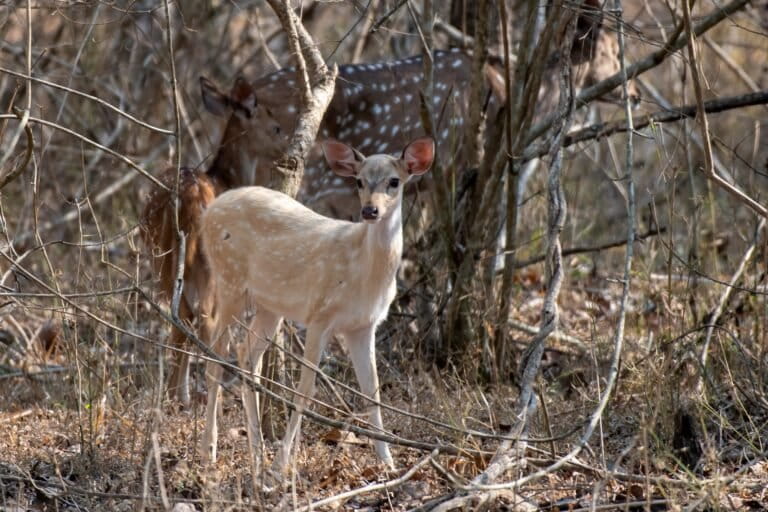
Banner image: Similar to the strawberry leopard, the golden tiger is a case of hypomelanism. This individual was photographed in Kaziranga National Park, Assam. Image by Mayuresh Hendre.
Credits