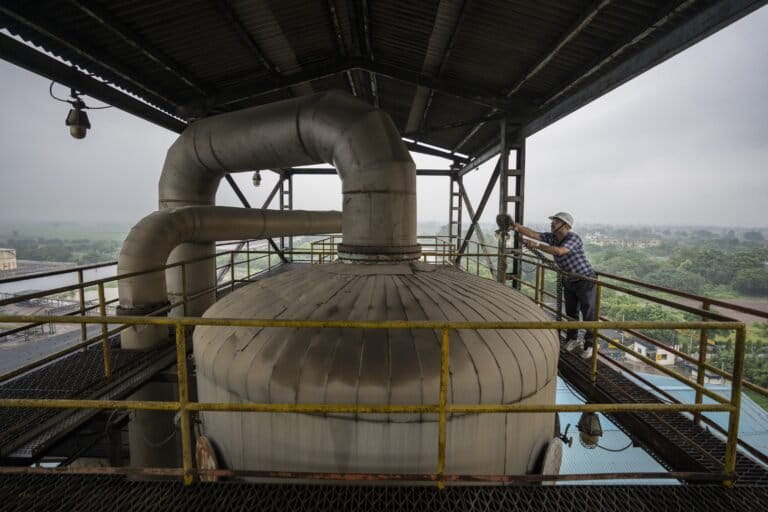
The Indian government has set emissions reductions targets for four more high-emitting industries as part of its upcoming compliance-based carbon market. These are the secondary aluminium, petroleum refinery, petrochemical and textile industries. Secondary aluminium refers to aluminium produced from recycled scrap.
The additions were made as an amendment to the Greenhouse Gases Emission Intensity Target Rules on January 16, which were officially notified in October 2025. The additions take the total number of industries covered by the scheme to eight, three months after it initially covered the aluminium, cement, chor-alkali, and paper and pulp industries.
The targets make it legally binding for industries listed to reduce their emissions. If industries perform better than their targets, they can generate carbon credits for trade on the compliance carbon market. However, failing to meet the target results will result in the payment of environmental compensation equal to twice the amount of the average carbon credit in the evaluation year. Industries are obligated to meet targets over two compliance years, 2025-2026 and 2026-2027.
According to an analysis by the CEEW, delays in operationalising the carbon market have led to less stringent targets and a missed opportunity in reducing an additional 2.8 metric tonnes of carbon dioxide or its equivalent (CO2e) by 2027. The government also planned to include the iron and fertiliser industries in the carbon market, but has failed to set targets for them so far. “Lower stringency could reduce the overall mitigation achieved under the scheme and lead to a potential oversupply of carbon credits, especially since the targets look achievable for sectors such as aluminium, iron and steel, and cement,” the analysis says.
The carbon market has the potential to reduce 47.84 metric tonnes of CO2e by 2027 if it covers all the sectors planned, as per the CEEW’s calculations. The targets have been calculated as emissions reductions per unit of output, to correspond with India’s goal of reducing its emissions intensity by 45% by 2030, compared to 2005 levels. The industries covered by the scheme are responsible for approximately 20% of India’s total emissions. The cement, iron, and steel sectors account for the largest shares.
Critics have also pointed out the exclusion of the power sector in the carbon trading scheme – India’s biggest emitter, responsible for 39% of emissions. “Excluding the power sector, significantly reduces the covered emissions and the possible reductions from them would be marginal,” the Centre for Science and Environment had said.
Banner image: An aluminium factory. Representative image by uc_rusal_photo_gallery via Wikimedia Commons (CC BY-SA 2.0).
Credits