- India’s environment ministry has exempted critical and atomic mineral mining from public consultations, citing national interest and security.
- The move faces strong opposition from Tamil Nadu, which has dealt with illegal beach sand mining for atomic minerals.
- The exemption risks an unjust energy transition, experts say.
A sweeping new executive order from the government has exempted the mining of critical and atomic minerals from public review, citing the role they play in serving national interests, including advancing the energy transition and strengthening defence mechanisms.
The order was made by the Ministry of Environment, Forests, and Climate Change on September 8, after the Department of Atomic Energy and the Ministry of Defence argued that exempting public consultations would fast track clearances for mining. In place of a public review, proposals for mining will be “appraised at the Central level,” the office memorandum carrying the order says.
Critical minerals such as copper and cobalt play an essential role in the development of several technologies including in space industry, electronics, technology and communications, renewable energy, and electric batteries. Atomic minerals such as uranium can help fuel nuclear power plants, which India plans on scaling to a 100 gigawatt capacity by 2047, while rare earth minerals are used in defence equipment.
But the removal of public consultation from the mining of these minerals has sparked vocal opposition from Tamil Nadu, which has experience with illegal beach sand mining used for atomic purposes.
Tamil Nadu Chief minister M.K. Stalin urged the central government to withdraw the exemption in a letter addressed to the Prime Minister. “Policy changes of such significance must be deliberated transparently in Parliament and State legislatures, with due consultation of the states and the public,” he wrote.
Pleas by the defence ministry and atomic department
Uncertainties in the global critical mineral supply chain have motivated India to create its own supply chain, driven by the principle of “atmanirbhar” or self-reliance. Accompanying regulations have changed to accommodate this ambition: In 2023, the government reclassified six non-radioactive atomic minerals – including lithium – as critical minerals because the “the non-atomic uses of these minerals far outweigh their atomic use.”
On August 4, the Ministry of Defence wrote to the environment ministry seeking an exemption for rare earth minerals used in manufacturing defence equipment from public consultations. “Mineral resources of these rare earth elements (REE) are scarce in India and their production and supply are concentrated in limited geographies around the world, which poses a supply risk for the country and requires steady supply of REEs from domestic mines,” the Ministry of Defence wrote.
A few weeks later, the Department of Atomic Energy also petitioned the Environment Ministry, saying that thorium extracted from monazite – a mineral found in beach sand – “is a potential nuclear fuel source for use in the third Atomic Energy programme.” Exempting thorium extraction as well as uranium mining from public review is necessary “to facilitate early operationalisation of mining projects,” the department said.
“Removing public consultations seems to be a signal that there will be more private partnership in the nuclear space, perhaps to consolidate supply chains and reduce cost overruns and delays,” said Kaveri Ashok, a research scientist leading the Sustainability division at CSTEP, a Delhi-based think tank.
India’s three-stage atomic energy programme – conceptualised in the 1950s – envisions scaling up nuclear energy by relying on uranium in the first stage, plutonium in the second stage, and thorium in the third stage. India is estimated to have 11.93 million tonnes of monazite resources in mineral deposits, mostly along the coasts of Odisha, Andhra Pradesh, and Tamil Nadu.
In Tamil Nadu, however, beach sand mining is particularly contentious – it was banned in 2013 after it was discovered that millions of tonnes of monazite had been illegally mined.
“There is a real concern about exposure to radioactivity during mining among people living close to these deposits. Removing the public consultation process is a direct infringement of their democratic rights to voice these concerns,” said M. Vetriselvan, an advocate with Poovulagin Nanbargal, an environmental NGO based in Chennai.
Critical mineral mining was opened up to the private sector in 2023, however, the mining of monazite is still controlled by a public enterprise under the Atomic Energy Regulatory Board.
Effecting a just transition
The need for public consultation is a necessary component of the environmental impact assessment (EIA) for large projects securing clearances. The latest executive order exempting atomic and critical mineral mining from public consultations follows a spate of other exemptions, which environmental experts have said take the teeth out of the clearance process.
“For any government balancing strategic priorities with social and environmental processes, consultations or consent can be understood as methods to build necessary support for defence or economic requirements,” said Kanchi Kohli, an independent environmental policy researcher.
Eliminating the role of local communities in decision-making that helps effect a transition away from fossil fuels can risk making the transition inequitable, experts have said. “In the long run, upstreaming these processes at the time of planning can ensure that regulatory frameworks don’t need to be amended in piecemeal manner only to accommodate inter-departmental or private sector asks. Instead processes can support the government’s own call to leave no one behind,” Kohli said.
While public consultations have been exempt, the environment ministry said project proponents undertaking mining still have to produce impact assessments and mitigation plans that create social and medical infrastructure and provide job opportunities for local communities.
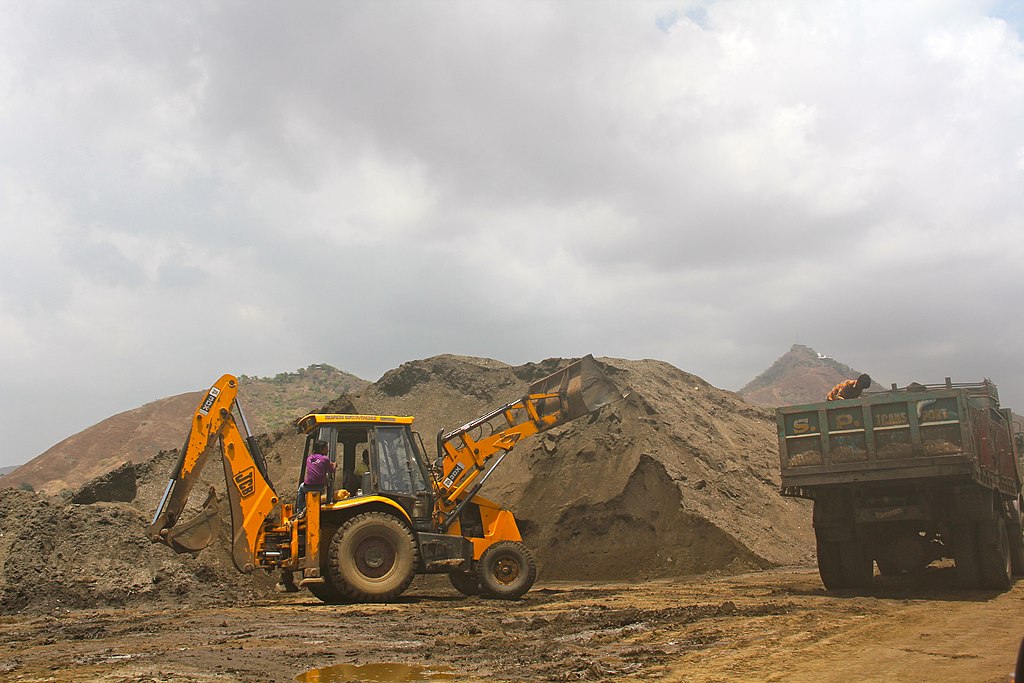
Banner image: Labourers at work at a chromium mine in Odisha. (AP Photo/Anupam Nath).
Credits