


- A long-term monitoring study in Telangana’s Kaghaznagar Forest Division and its adjoining areas has found that long-billed vultures are breeding less successfully.
- Toxic effluents from a paper mill, polluting the vultures’ main water source, were linked to poor breeding success.
- Researchers urge stricter pollution control, regular water testing, carcass necropsies, and the creation of “Vulture Safe Zones” to protect one of India’s last remaining strongholds for long-billed vultures.
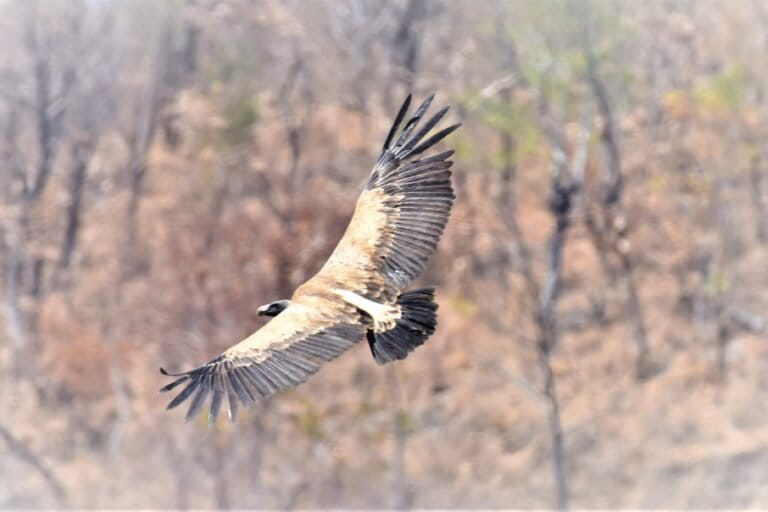
High on the sandstone cliffs of Telangana’s Kaghaznagar Forest Division, long-billed vultures (Gyps indicus) once nested in dozens. Their rhythmic flights in the skies were a familiar sight for local people. Today, however, only a handful remain. A 14-year study has now found that these critically endangered birds are breeding less successfully.
“The long-billed vulture has undergone severe population declines across the Indian subcontinent, primarily due to diclofenac [a veterinary drug] poisoning. It’s also a slow reproducer, typically raising only one nestling per year,” says Ravikanth Manchiryala, a researcher from the Department of Zoology and Wildlife Biology, AVC College, Tamil Nadu, and the first author of the study. “Most earlier studies were short-term or focused on multiple species of Gyps and offered only general insights. This one, however, specifically tracked this species’ breeding ecology, nest success, and how environmental factors affect reproduction over time,” he added.
Tracking a slow decline
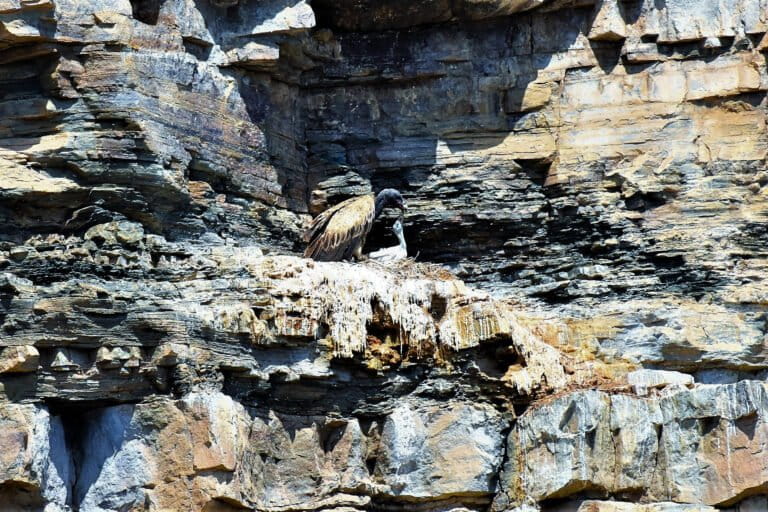
Between 2010 and 2023, researchers monitored 23 nests across two cliff-nesting colonies in the Kaghaznagar Forest Division and adjoining parts of the Deccan Plateau, at the junction of Telangana, Maharashtra, and Chhattisgarh states. These cliffs, known as Palarapu and Lakkameda, lie along the Peddavagu stream and Pranahita river, a landscape that also serves as a corridor linking the Kawal, Tadoba-Andhari, and Indravati Tiger Reserves.
Fortnightly surveys from observation points about 200 metres from the cliffs documented each phase of the breeding cycle, from the onset of breeding to late nestling rearing. Breeding results were compared annually against environmental variables including temperature, rainfall, wind speed and direction, surface pressure, dew, and local water toxicity. Statistical models were used to identify which factors most influenced breeding success.
“This long-term dataset revealed detailed insights into their breeding biology. The dataset also captured annual variations in nesting success and nestling survival,” says Aamer Sohel Khan, wildlife biologist and a HDR Fellow from the School of Animal and Veterinary Science, University of Adelaide, and the study’s co-author. He added that the data set also highlighted patterns of consistent site use (site fidelity) and resilience in certain colonies.

The paper trail
During the study period, the researchers recorded 161 pairs that had occupied nests, attempting to breed, which laid 116 eggs, of which 85 chicks successfully reached the stage to leave the nest and fly. However, the numbers sharply declined over the years: from 23 occupied nests in 2019 to 15 in 2020, four in 2021, and just one in both 2022 and 2023.
The strongest negative influence was found to be the level of toxicity in the effluent discharged from the Sirpur Paper Mill into the Peddavagu stream. The effluent, a dark-black liquid containing chemicals, is a known environmental hazard. Previous analyses found that many of these parameters exceeded the Bureau of Indian Standards safety limits.
“Vultures drink large quantities of water after feeding. The Peddavagu stream, used by humans, cattle, and wildlife, is their primary water source,” says Nagarajan Baskaran, from the Mammalian Biology Lab, AVC College, and corresponding author of the study. After the reopening of the Sirpur Paper Mill, which was shut from 2014 to 2017, hazardous effluents re-entered the stream, likely affecting adult health and egg viability, he says. “Vultures’ long lifespans and scavenging habits make them especially vulnerable to chronic chemical exposure and bioaccumulation,” Baskaran adds.
The field teams also documented three adult carcasses near the stream between 2019 and 2023. While toxicological testing wasn’t performed on these birds, prior water assessments indicated high concentrations of cadmium, copper, lead, nickel, and zinc, all toxic to birds.
Environmental factors also shaped breeding outcomes, the study found. Hatching success was higher in cooler years, while heavy rainfall reduced egg survival. Interestingly, wind speed had a positive effect. “Higher wind speeds enhance flight efficiency, reducing adults’ energy costs during foraging and allowing them to feed chicks more regularly. Better airflow may also ventilate nests, lowering heat stress and parasite load,” explains Manchiryala.
At the microhabitat level, nest depth and vegetation cover mattered. Nests deeper into cliffs or shaded by greenery fared better, whereas those closer to human activity had lower success rates.
A regional conservation crisis
India is home to about 97% of the global population of long-billed vultures, estimated at just over 12,000 individuals. While some recovery has been seen in Rajasthan and Madhya Pradesh, the Deccan colonies appear to be in decline.
“The current fledging success rate is barely sufficient to sustain a stable population, given the species’ slow breeding cycle and long developmental stages. Prolonged breeding increases exposure to environmental hazards and human-related threats, raising the risk of reproductive failure. Even small declines in breeding success could accelerate population loss and jeopardise the species’ long-term survival in the region,” says Khan.
The researchers recommend immediate steps such as necropsy of carcasses, physiological monitoring of stress and reproductive hormones, detailed water contamination analysis, stricter industrial discharge monitoring, and establishing “Vulture Safe Zones” in collaboration with state forest departments. “Targeted strategies addressing pollution, habitat degradation, and legacy threats like diclofenac, are crucial to prevent collapse,” says Baskaran.
Read more: Measuring the scavenging value of vultures
Banner image: Vulture nest numbers have sharply declined in recent years, from 23 occupied nests in 2019 to just one in both 2022 and 2023, across two cliff-nesting colonies in the Kaghaznagar Forest Division and adjoining parts of the Deccan Plateau, at the junction of Telangana, Maharashtra, and Chhattisgarh. Image by Ravikanth Manchiryala.
Credits


