- A Siang river basin conservation project shows how local ecological knowledge can effectively complement scientific efforts to study the critically endangered Chinese pangolin.
- Arunachal Pradesh is considered a key stronghold for the species, yet systematic data on its distribution and status are still lacking.
- Adi community knowledge links pangolin presence to jhum cultivation, where decaying felled wood attracts ants and termites which are pangolin’s primary food source.
“Earlier, one could find pangolins near the village. But not anymore,” says Odan Ratan of the Adi community, an Indigenous people from the Siang river basin in Arunachal Pradesh. Ratan, who hails from Damro village in the Upper Siang district, works as a field collaborator with the Nature Conservation Foundation (NCF), a wildlife conservation and research organisation based in Mysore, Karnataka. He is part of a project to study the critically endangered Chinese pangolin in Arunachal Pradesh.
In a recent short paper published in the Oryx journal, NCF researchers including Ratan demonstrate improved camera trap capture rates of pangolins in the region when the traditional knowledge of the Adi people was utilised.
Pangolins are nocturnal insectivores, encased in scales, that curl up into a tight ball when threatened. They hold the unfortunate title of the most trafficked mammal in the world.
The Chinese pangolin (Manis pentadactyla) is one of the two pangolin species found in India, the other being Indian pangolin (Manis crassicaudata). It is distributed across the northeastern states and in northern West Bengal. Arunachal Pradesh is considered one of its strongholds, but there is almost no recent systematic data on the population and distribution status of the species in the region.

Adopting local ecological knowledge
Researchers visited over 100 Adi villages, spending time with the community and learning from the elders about pangolins’ locations and the ancestral stories associated with the species. “Unlike scientific knowledge, local knowledge is not universal. It varies from person to person, basti to basti (settlement),” says Chiging Pilia from the neighbouring Ziro Valley and leads the pangolin research project in Arunachal Pradesh.
“Some hunters would look for the sound of pangolins snoring inside the burrow, whereas others would keep an eye out for the presence of flies nearby, attracted by the pheromones pangolins secrete,” he explains. The team collected these nuggets of valuable ecological knowledge and identified what to prioritise based on their practicality and relevance.
For the preliminary burrow-targeted camera-trapping survey, researchers chose the Daying Ering Wildlife Sanctuary, a protected area (PA) within the Siang river basin. Despite evidence of high pangolin occupancy established from the interviews of community members, no pangolin surveys had been conducted in the region before.
The team deployed nine camera traps in the PA, seven of which were positioned based on Adi ecological knowledge which garnered the desired results. Over a month, across 232 operational camera trap nights, the team captured 41 pangolin photographs from the seven cameras, an overall capture rate of 5.1 per 100 trap nights — comparable to or higher than those reported in other studies from Asia and Africa.
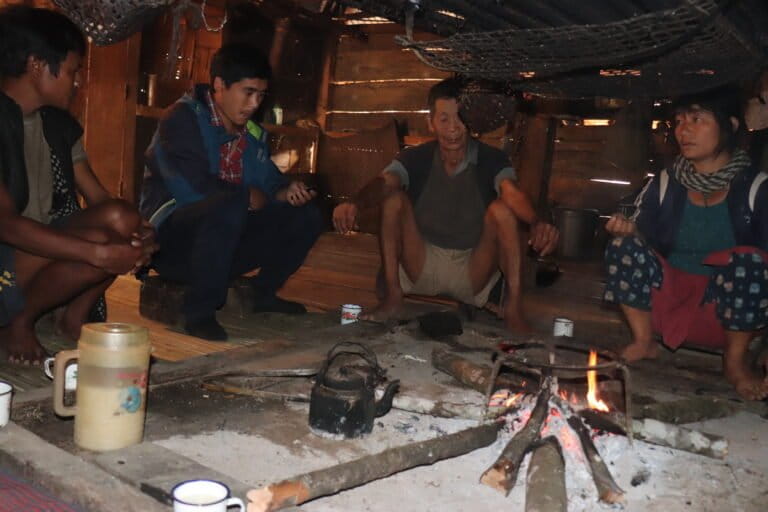

The researchers, however, note that just identifying potential occurrence sites from locals won’t necessarily bear results. “Pangolins are a generalist species and are found everywhere. One needs to understand their microhabitats,” says Pilia. These microhabitats could vary from their burrows to a rotten tree stump that attracts their prey or a termite mound, among others. “In case of a burrow: are there claw marks at the entrance? Is the nearby area clear of litter and plants, which pangolins drag in to make their nest? Are there spiderwebs lining the walls?” These are signs that could point to a pangolin’s activities, according to Pilia. “A surface-level understanding of local knowledge won’t be sufficient. Crucially, we must understand its real meaning and learn to rely on it ethically — only then can it complement our scientific processes,” he adds.
Ambika Khatiwada, a National Geographic Explorer researching Chinese pangolins in the eastern Himalayas of Nepal, has also utilised local knowledge to locate pangolin burrows, thereby increasing detection. “We found that due to human presence in the area, the pangolins may not visit for the first few days; however, the likelihood of capturing them on camera is high once they feel safe to return,” he says.
Jhum cultivation and pangolins
A significant takeaway for the research team was the correlation between jhum lands and pangolins. According to the Adi people, pangolins are seen near areas where jhum or shifting cultivation (a traditional method involving clearing a patch of forest, cultivating it for a few years, and then allowing it to regenerate naturally) is practised.
In their survey of pangolin distribution in the East and Upper Siang districts, most of the pangolin sightings were from abandoned jhum kheti (farms), says Pilia. The decaying wood of felled trees is a rich food source for ants and termites, in turn a favourite food of the pangolin. Khatiwada has noticed the same in his study region in Nepal. “We found pangolin burrows close to agricultural lands in rural Nepal. It could also be linked to organic farming. In rural farmlands, the use of insecticides and pesticides remains minimal, allowing populations of termites and ants to prosper.”

However, the practice of jhum cultivation is declining in the Siang river basin, according to Adi researcher Ratan. “Earlier, the jhum land would be bigger than the basti itself. Nowadays, most people prefer to practice irrigation farming or wet rice cultivation.”
Jhum cultivation has historically been linked to deforestation and soil erosion but recent research suggests that these concerns may have been overstated. A 2023 paper published in Nature Scientific Reports journal compared the soil organic carbon (SOC) dynamics of jhum land, fallow jhum land, and natural forests in the hills of Arunachal Pradesh. “In the study, ‘jhum land’ refers to actively cultivated plots, areas that were recently cleared and burned for cropping, and ‘fallow jhum land’ refers to previously cultivated jhum plots that have been abandoned and left to regrow natural vegetation,” says Jitendra Kumar, the author of the paper and a senior scientist at the ICAR-Indian Institute of Soil Science, Bhopal.
The study’s findings show that jhum cultivation drastically reduces soil fertility and carbon storage; however, after a two-year fallow period, it starts to recover. “In the study, fallow jhum was left idle for only two years. For a longer 10 or 12-year cycle, the SOC recovery would be significantly higher, possibly achieving a quasi-steady state similar to undisturbed forests,” Kumar adds. According to Ratan, the Adi community follows a strict 12-year fallow cycle.
Kumar notes that while long fallow cycles can render the system carbon neutral by offsetting emissions through forest regrowth, short fallow cycles can result in a net carbon loss. The Arunachal Pradesh State Biodiversity Strategy and Action Plan 2025-2035 recognises jhum cultivation as a vital cultural practice and aims to empower communities to manage jhum landscapes sustainably.
Khatiwada recognises that it is critical to safeguard the Chinese pangolin habitats in Arunachal Pradesh. “The species is more prevalent in human-dominated landscapes, making community engagement programmes crucial for its long-term conservation and management,” he says.
The research team at NCF aims to expand their camera-trapping efforts beyond PAs to better understand human-pangolin coexistence dynamics, thereby laying the foundations for evidence-based, rights-based community-led conservation. “I am focusing on my research right now. Conservation can come in later, if and when the community wants it,” Pilia says.
Read more: Evolving hunting practices pose an increasing threat to wildlife
Banner image: One of the nine camera traps (seven of which were placed on the advice of Adi community members) yielded this image of a Chinese pangolin digging a burrow. Image by Chiging Pilia/NCF.
Credits