- A new study from Tadoba-Andhari Tiger Reserve found that dholes feed almost entirely on wild prey, with livestock making up only a negligible part of their diet.
- Researchers collected small pinches of scat material and tested the samples through DNA metabarcoding method to assess dhole diet. They say that this method offers more accuracy compared to older methods which had more biases.
- The findings suggest that maintaining a healthy wild prey population is key to dhole conservation and could reduce human-wildlife conflict by limiting livestock predation.
Dholes (Cuon alpinus), also known as Asiatic wild dogs, are among the most threatened carnivores globally and are currently listed as ‘endangered’ by the International Union for Conservation of Nature (IUCN). Understanding what they eat, can offer clues that will aid in their conservation. Researchers have now developed a new technique to analyse their diet by using only “small pinches” of scat material.
Non-invasive fecal samples have become increasingly important for studying the diet of elusive and endangered species, as they provide finer taxonomic resolution. But while most recent metabarcoding studies have used methods involving the collection of whole scats in ziplock bags or centrifuge tubes with silica beads, molecular ecologist Abhinav Tyagi and his colleagues took a different approach.
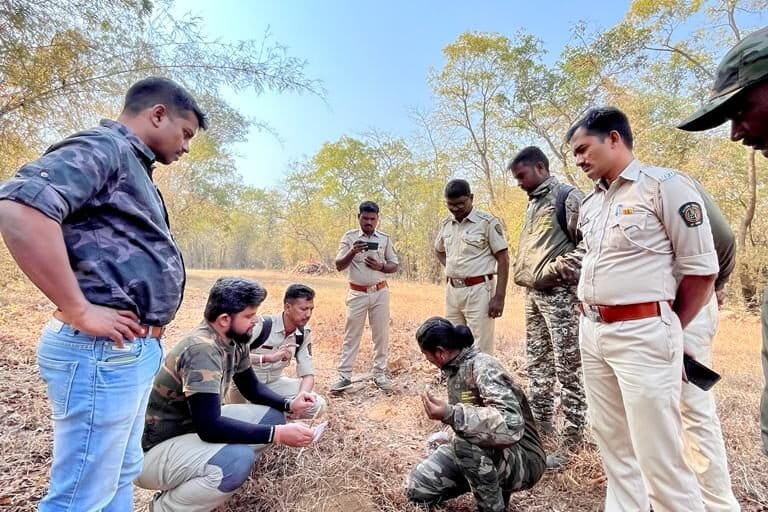
While researching dhole diet inside the Tadoba-Andhari Tiger Reserve in Maharashtra, forest staff trained by Tyagi, instead of scooping up entire piles of dhole scat from the ground, collected only “small pinches” of material. Samples were collected during the monsoon (August-September 2022) and winter (January-February 2023).
The study, published in Environmental DNA, is a collaboration between the National Centre for Biological Sciences (NCBS) and the Maharashtra Forest Department, and uses “DNA metabarcoding to assess spatial and seasonal variation in dhole diet from a high-density dhole landscape.”
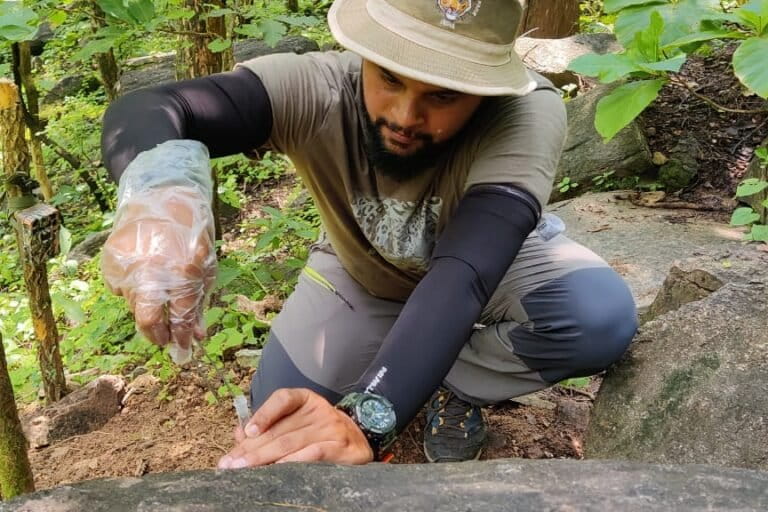
“The study found, their diet, irrespective of season, irrespective of area, is mostly wild prey [sambar deer, wild boar, and chital],” Tyagi, who led the study, told Mongabay-India. Livestock made up a negligible share of their diet, even in the reserve’s buffer zones, where livestock grazing is common.
Arjun Srivathsa, a wildlife biologist affiliated with the Wildlife Conservation Society-India, told Mongabay-India in an email response that the findings are consistent with what has been documented across the species’ range.
“Dholes are hypercarnivores and rely substantially on wild prey even when there is domestic livestock available in the landscape,” Srivathsa said. The new methodology, he added, strengthens rather than complicates that picture, offering “more reliability and clarity.” Srivathsa provided comments on the study’s manuscript before it was published.
Minimal sample, maximum insight
DNA metabarcoding is a technique that extracts all the DNA from a sample, amplifies genetic sequences using universal markers, and matches them against a database that can cover tens of thousands of species.
“Whatever NCBI [National Centre for Biotechnology Information] has, I downloaded everything and created a reference library,” Tyagi said, referring to the publicly available genetic database. The method has been in use globally for more than a decade. But it is used in this research for the first time to understand dietary patterns in dholes. To stop the machine from copying dhole DNA and focus instead on the DNA of the animals they had eaten, the researchers created a short genetic sequence that blocks dhole DNA from being amplified.
The team also faced another challenge. The sequencing machine needs a mix of different DNA sequences at the start of the process to work properly. Usually, scientists add artificial bacterial DNA to create this diversity, but doing so uses up about 20% of the machine’s capacity.
To avoid this, the researchers designed special primers — short DNA sequences that kick-start DNA copying— with random starting sequences that generated the required diversity within the sample itself. This allowed them to use the machine’s full sequencing capacity. As a result, the new method was both more accurate and more efficient.

Traditional approaches to identify the DNA of species, like microhistology that uses prey animals’ unique body hair patterns as seen under a microscope, are vulnerable to observer bias. “Different people can categorise hair differently, and it induces a human or an observer’s bias. But DNA metabarcoding and its analyses using bioinformatics tools remove such bias and make data comparable across studies,” Tyagi said.
Within the same species, hair morphology can vary depending on the animal’s age, sex, and the body part from which the hair comes. Different species can also have similar-looking hair.
“Whenever there is doubt regarding a sample, we just don’t take it to avoid misclassification,” said Abraham Pious, a researcher who has used microhistology to study dholes in the Western Ghats tea agroforests of Valparai, Mongabay-India.
“The advantage in Valparai is that there are no tigers in the plateau. And very few leopards. So, the misidentification of dhole scats is much less likely compared to other locations like PAs (Protected Areas),” he added. Microhistology is restricted to species in its reference library. Essentially, the species absent from the reference library may be missed. Pious said, it “is much cheaper, and you get an overall idea,” he said. “But its accuracy would be much lower.”
Studies have increasingly flagged that the “older methods are prone to errors like misidentification of species or non-detection of certain species, which preclude our ability to fully understand the entire breadth of carnivore diet,” Srivathsa said. “This meta-barcoding method circumvents these issues and holds promise of offering a much more reliable understanding of carnivore diet.”
But metabarcoding is expensive, Pious pointed out. Higher costs in metabarcoding are also because of “access to infrastructure and more advanced lab facilities (for extractions, sequencing, etc),” Srivathsa explained. “But this is a new approach, so the costs are higher now. As with any new tech, over time, the costs will likely reduce, and it will be adopted more widely in carnivore studies.”
What dholes eat and why it matters
The global population of dholes is estimated at between 1,000 and 2,000 adults. Almost 80% of them have disappeared from their original range. In India, they have benefited from tiger conservation, since the two species share habitats.
Tyagi’s study found that dholes at Tadoba fed overwhelmingly on wild prey — sambar, chital, and wild pig. This was consistent for both core and buffer zones and across seasons. Livestock appeared only marginally in the diet. And, in the monsoon season, 15 prey species were detected.
And, their interactions with other Panthera species, tigers, and leopards, suggested “increased trophic or spatial interactions among co-occurring carnivores during the monsoon”, according to the study.
The logic is that dholes are forest-dependent and competition-sensitive species. Even outside the protected areas, such as in tea plantations, Pious’s 2025 study found that the dhole occupied spaces away from human settlements. Pious said of northeast India, “As livestock hunting increases, the human attitude towards dholes leads to retaliatory killing. That is one of the key sources of conflict there. There’s also a lot of complex histories of human-nature relationships, including ritualistic hunting, which has sustained over centuries.”
The dietary data from Tadoba points to a simple conservation insight: “If we increase wild prey density, then dhole populations might come up in numbers,” Tyagi said. “That’s the broad takeaway.”
Pious explained how increasing wild prey is a delicate process, as it would impact people living in the buffer zones. The herbivores would raid crops and damage them. “Conservation should never be at the cost of people who co-exist with the animals.”
Understanding key species can help prioritise ungulate species for restoration efforts in prey-depleted regions, the study notes. “Standardising diet assessments using metabarcoding can thus play an important role in shaping broader carnivore management, guiding targeted prey monitoring, and informing conflict mitigation strategies across the subcontinent,” it concludes.
Banner image: Dholes feed on a deer in Karnataka. Representative image by T.A. Joseph via Flickr (CC BY-NC 2.0).
Read more: A community-managed goat bank supports farmers for livestock losses
Credits