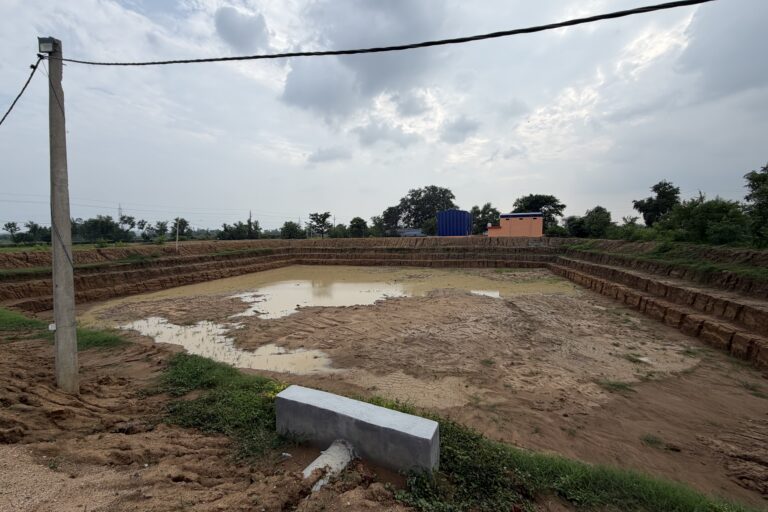
- Kiraksal, a small village in Maharashtra, has managed to achieve water sufficiency through watershed development by the collective efforts of people, government, and civil society organisations.
- Kiraksal now has drinking water all year round, supplied by the gram panchayat. Through water budgeting and crop management, there is water for both kharif and rabi crops, as well as cattle.
- Kiraksal is in a highly drought-prone region and recent rainfall data shows extreme fluctuations.
Amol Katkar was a college student in 2002 when Kiraksal experienced a terrible drought. “I remember children roaming from village to village on foot or on their cycles in search of drinking water. Cattle camps were set up and farmers were compelled to leave their homes to stay with their cattle in neighbouring villages,” shared Katkar, sarpanch of Kiraksal from 2015 to 2018.
Kiraksal is a village located approximately 75 km east of Satara headquarters in Maharashtra’s Maan taluka and covers about 18 sq km of the Deccan Plateau terrain.
The semi-arid climate here, with low average annual rainfall (300-500 mm), and weathered basalt, known locally as “khadak”, makes it a challenging landscape for agriculture.
History repeated itself in 2012, when Maan taluka was again declared drought-hit by the Maharashtra government. “There was a severe drought, and Maan, Atpadi, and Sangola talukas were among the worst affected,” recalls Avinash Pol, Chief Advisor at the Paani Foundation. As before, Maan taluka was heavily dependent on tankers and farmers were once again forced to leave their homes and settle in cattle camps. It was at this crucial time that Pol visited Kiraksal, conducted a gram sabha, and advised Katkar (who was a gram panchayat member at the time) and a few other villagers on watershed management.


How water stewardship was built in Kiraksal
“Initially, around 50 people would attend the watershed training sessions, as people thought of this as the government’s job,” recalls Katkar. However, things changed in 2017, when Katkar and four others attended a training session by Paani Foundation. They then brought back these lessons and conducted these sessions in Kiraksal for 87 villagers. The momentum built slowly from there.
Around 500 people participated in watershed management that year through shramdaan, a voluntary contribution of their time and labour. The village fair was cancelled that year, and Kiraksal decided to spend the money on building their watershed management infrastructure instead. “Many people from the village contributed financially as well; we raised approximately ₹600,000 through people’s contributions,” shares Katkar.
Water literacy increased in the village, and everyone was equipped with the techniques of watershed management. College students were trained to conduct line-out and mark-out exercises for contour trenches, contour bunds, and stone bunds. “We created 25-30 groups of 20 people each, consisting of people from different socioeconomic backgrounds. They worked together like one family. Each group was named after an Indian river: Narmada, Godavari, Kaveri, Ganga, Yamuna, etc.,” shares Amol Katkar.
This initiative also spread awareness about water conservation, and villagers started efforts to conserve water through methods like drip irrigation. “Before we started watershed management, our water lasted only till January. Now we have water all year round,” shares Amol Katkar. Watershed development, along with the construction of the Urmodi Canal, has improved agricultural output, fruit farming, milk production, and even made sugarcane farming (which is water-intensive) possible in Kiraksal.

The success, Katkar notes, was a result of collective efforts. “Many government and NGO schemes, as well as people’s contribution, both in terms of time, labour, and money helped us. We got scientific training from Paani Foundation; we received funding through government schemes such as Jalyukt Shivar, Jalyukta Shivar 2.0, Atal Bhujal Yojana, Adarsh Gram Yojana. Watershed Organisation Trust brought in some CSR funds for us, and AFARM helped us build a deep CCT (continuous contour trench),” shares Amol Katkar.
Since 2012, Kiraksal has constructed several watershed development structures, including oghal (small streams), loose boulder structures, deep continuous contour trenches, contour bunds, compartment bunding, gabion structures, farm ponds, recharge shafts, earthen naala bunds, well recharge, check dams, concrete cement bunds, jaltaara, and forest ponds. As Vishal Katkar, youth from Kiraksal who has participated in watershed management since 2019 says, “We built several ‘natural utensils’ to store rain water. Just like we need utensils at home for storage, villages also need to work on constructing and maintaining their utensils in nature.”
Rohan Dilip Katkar, a farmer from Kiraksal, notes that the canal, which started in 2014, has contributed at least 40% to the village’s water sufficiency. “Fertile land has increased due to watershed management work. People who had 10 guntha (0.25 acres) of productive land now have about 2 acres,” he shared. He added that the impact extends beyond Kiraksal. “Kiraksal is at a higher altitude, so neighbouring villages in a radius of up to 10 kilometres have increased their greenery due to our watershed management efforts,” he said.
In 2017, Maharashtra experienced a drought again, but in Kiraksal the impact was not felt as much due to the canal and the watershed work that started in 2012.
Megha S. Shinde, senior geologist with the Groundwater Surveys and Development Agency, Satara, shares, “This area has weathered basalt, which has a specific yield (volume of water that percolates in the ground) of 3%. This means that if you pour 100 litres of water in basalt, only 3 litres percolate. With such little water, Kiraksal has not only managed to provide drinking water and water for agricultural use, but also maintained their biodiversity, which I find truly impressive.”


Impact on livelihoods
Haridas Katkar, a dairy farmer, says that before watershed management started in the village, the impact of drought was much more severe. As the canal water started coming regularly, year on year the fodder and water situation got progressively better.
When he started his dairy in 2020, he produced 70 litres of milk a day. As of 2026, he is now producing up to 300 litres a day. “In Kiraksal, we also ensure that borewells are not constructed deeper than 200 feet (61 m). We also have sakhli bandhare (chain dams) built under a government scheme. All this contributed to us becoming water and fodder sufficient,” he shared.
With increased water in the area, fruit farming flourished as well. Satish More, a retired civil engineer who has now taken up farming in Kiraksal, shares that in his childhood there was no scope for grape farming here. “We had to go to faraway villages just to see a grape farm. Now we have grapes growing in Kiraksal itself,” he shares. The transformation, he explains, goes beyond fruit farming. “Earlier, all our farming was rain-dependent. We could manage only one crop per season in the village. Now, there is an increase in cash crops. People are surprised that we can grow sugarcane in this drought-prone area,” More shares. More has an 8-acre farm where he grows custard apples, lemons, sunflowers, wheat, jowar, turmeric, and sugarcane. “We don’t practice large-scale sugarcane farming here; we grow it keeping in mind our water management capacity,” he clarifies.
As noted by Megha S. Shinde, in her 2025 study of Kiraksal’s water conservation model, the improved water sufficiency has resulted in a few instances of reverse migration. She also notes, “Agricultural productivity enhanced by 35% (Taluka Agriculture Officer data), milk production grew from 2,000 litres to 4,850 litres daily (Block Veterinary Officer data). Annual per hectare income rose by ₹200,000.”

Lessons from Kiraksal for other drought-hit regions
Supriya Maruti Shinde, project manager at WOTR who has been working in Kiraksal since 2024, shares the unity among the residents of Kiraksal is what makes watershed management here a success. “People of all ages in Kiraksal all come together for this cause. They are not averse to trying new things, and they trust their leadership. Everyone here casually speaks about CCTs, deep CCTs; they know their watershed management structures well,” she shares.
Avinash Pol, Chief Advisor to Paani Foundation, who has followed Kiraksal’s journey since 2012, shares that Kiraksal’s success did not happen in a few days. “Whether it is a government scheme, or NGO work, it needs visionary and dedicated leadership to be effective. Kiraksal benefited from such leadership in Amol Katkar, and crucially the people here decided to understand the science of watershed management.”
Vishal Katkar shares that he has not missed a single watershed management training since 2019. “Paani Foundation’s training sessions made the science of watershed management accessible to every single person in the village. They truly made it a movement by including everyone — the poorest of the poor, who truly need this knowledge — a part of the sessions. They showed us all the practical applications of the science of watersheds, so it started feeling easy.” The young people doing all the work in Kiraksal, he added, did very technically accurate work, because there was a sense of ownership.
Kiraksal’s unity is something other villages can learn from, shares Megha S. Shinde. “They work very well together and are all very aware of the geography, geology, and topography of their village. They have increased micro irrigation, and ensured that surface water is extracted to a minimum. Even their groundwater levels increase marginally year on year,” she shared.
Amol Katkar shares that most watershed management structures have a life of 10-15 years, after which they have to be either repaired or constructed again. “In Kiraksal, we might not need to repair our structures very soon because we try to ensure that minimum silt enters the structures. By reducing forest fires and maintaining grass cover, we ensure that there is minimum siltation.”
Banner image: A cement naala baandh in Kiraksal constructed in 2017. Image by Vinaya Kurtkoti.
Read more: Village documents 600 species through a community-led survey
Credits