- Planting trees in a cold desert like Ladakh stems from a misunderstanding about the local ecology.
- Mass plantation drives become acts of territorialisation – a way to claim space, assert control over nature and people, and demonstrate action against climate change.
- Experts say that Ladakh needs a policy tailored to its fragile ecology, one that prioritises ecosystem regeneration and resilience over numbers of saplings planted.
- The views in the commentary are that of the author.
In the short-lived summer of Ladakh’s cold desert, patches of greenery bring a kind of joy that is hard to put into words. The sight of green against stark brown mountains is visually pleasing and lifts the spirit. Green is linked to fertility, abundance and safety in human evolution. It carries a deep psychological association with life and well-being that people instantly feel good around green. For much of my life, I believed planting trees was an unquestioned good.
This belief is not mine alone and it has become almost universal. Across India especially in Ladakh, tree plantation drives are celebrated as acts of healing. People of Ladakh feel deeply longing for green that it has now become a mass infatuation with trees. Officials speak proudly of numbers. According to data from Leh’s forest department, Leh Forest Division which oversees the district has planted 548,369 trees across 154 hectares between 2019 and 2024, fencing more than 110,000 running feet to protect these plantations. Along with them the NGOs, religious bodies, schools, communities and even army units have joined the enthusiasm of planting thousands more saplings across the cold desert.
Officially the goal is to fight desertification and sequester carbon in Ladakh. The vision sounds noble on paper but in practice, this strategy reveals a misunderstanding that could end up harming the very land it seeks to save.

The cold desert
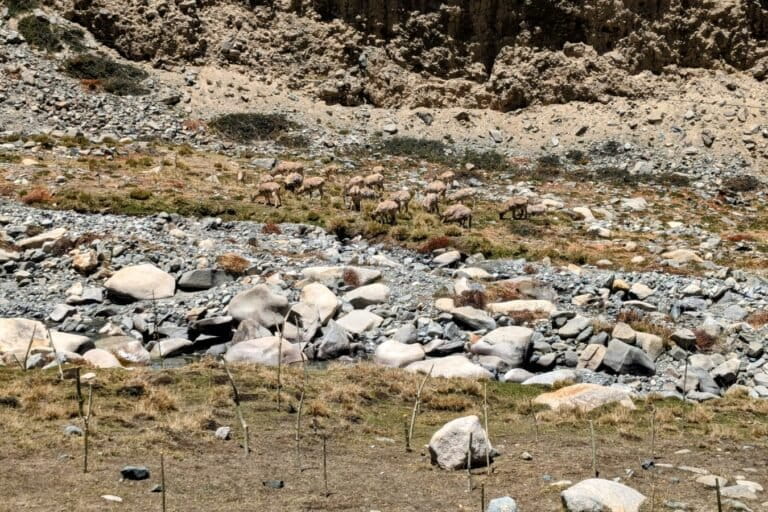
Ladakh is a fragile ecosystem in the Indian sub-continent where the ecological reality is very different from the rest. It is a cold desert, glaciers are retreating, winds are harsh and water is precious. Life has evolved accordingly. Ladakh is not an ‘empty wasteland,’ as it is often described.
“What looks barren to outsiders is in fact a web of hardy shrubs, grasslands, and wetlands that sustain wildlife and local livelihoods. Scientists have identified more than 1,000 species of flora and fauna in Ladakh’s cold desert and nearly 40% of its plants are medicinal. These species have adapted over centuries and they are part of an ancient ecological balance which supports both local communities and biodiversity,” says Kunzes Angmo, an assistant professor and ecologist at Sher-e-Kashmir University of Agricultural Science and Technology of Kashmir, Leh (SKUAST). These Open Natural Ecosystems (ONEs) are the true resilience of Ladakh. Yet, because they are not lush forests, they are often dismissed as barren and wasteland.
Planting trees
Tree planting here is not as simple as dropping a sapling into the soil. In Ladakh’s thin air, rocky earth and short summers, saplings rarely survive without constant care. Survival rates are low. Irrigation becomes essential not just in the early stage but often long after. “Tree maturity takes two times longer in Changthang than in Leh, the quality differs a lot and constant observation is required,” says Stanzin Gyalik, Range Officer, Forest Department Nyoma who oversees the entire Changthang region. “To continue provision of the tree plantation, forest watch/ward has been appointed at the village level,” he adds.

Forest ward Tsering Choldan who has worked over 40 years looking after tree plantations in Changthang Nyoma, says, “I truly believe that planting trees is a holy act and I love working as a forest guard while taking care of these trees in high altitude. It is true that the trees don’t grow at alluvial soils particularly along the plains of the Indus River and its tributaries.”
Every drop given to plantations is a drop taken from something else, most villages depend on glacier melt water for agriculture, natural spring for drinking purposes and some even from fragile wetlands. While communities are already spending hours managing scarce water resources, large-scale plantations only increase the pressure, lowering water tables and reducing run-off that sustains natural vegetation. In villages where there are limited natural water resources, the Forest Division introduced borewells to access underground water in Koyul, Tsega and Chumathang.
“The soil suffers too. Studies across arid regions show that forcing trees into drylands can desiccate the soil, stunt growth and block natural regeneration. In many cases, the landscape is left worse than before: thirsty plantations that fail to thrive alongside native ecosystems that are quietly weakened,” Angmo reiterates the damaging effect of tree plantation in the cold desert.
Why is tree planting popular?
If the ecological costs are so high, why do tree plantation drives remain so popular? The answer lies partly in psychology and partly in politics. Psychologically, green is universally appealing. From an evolutionary perspective, greenery is associated with water, food and safety. Even today, people feel comforted by the sight of trees in barren landscapes. In Ladakh, where summers are short and stark, a patch of green feels like joy. This emotional pull cannot be underestimated.
Politically, tree planting is a convenient symbol. Governments and organisations can count the number of saplings, declare hectares “restored,” and report carbon offsets. Mass plantation drives become acts of territorialisation — a way to claim space, assert control over nature and people, and demonstrate action against climate change. In Ladakh while the forest department plants mostly native willow species, a mix of native and non-native varieties of poplar like Salix alba and Populus deltoides are also planted. There are also some sea-buckthorn, tamarisk and fruit-tree plantations led by villages.
But behind the statistics and ceremonies, the ecological reality is ignored. “Plantations are promoted as innovative solutions when in fact they repeat a long history of misunderstanding drylands. From colonial forestry to modern carbon markets, the obsession with trees has too often overshadowed the value of grasslands, shrublands and deserts,” highlights Mayank Kohli, PhD, INSPIRE Campus Fellow at The National Centre for Biological Sciences (NCBS), Bengaluru.
Ignoring the ecological value of grasslands
In Ladakh’s cold desert, planting trees is not simply about adding greenery but unfortunately it is altering nature itself. Endemic plants and grasses which have evolved over centuries to survive in this harsh high-altitude climate are being pushed aside in favour of non-native forest species introduced through mass plantation drives.
“Science shows that grasslands, not forests, are the real carbon banks of drylands as most of the carbon is stored underground in their extensive root systems. When saplings are planted, the very act of digging disturbs the soil and releases this stored carbon. In many cases, the supposed solution of tree planting actually leads to a net loss of carbon. Yet grasslands are often overlooked in policy because they cannot be commodified as easily as forests,” says Kohli.
Angmo stresses, “What Ladakh needs is not more plantations but a policy tailored to its fragile ecology – one that prioritises ecosystem regeneration and resilience over numbers of saplings planted. Protecting grasslands and endemic plants may not be as visually striking as rows of tree saplings but it is far more critical for sustaining biodiversity, water systems and long-term climate resilience in the cold desert.”

It is not that trees are bad. In other regions, they may very well help. But in Ladakh, where the ecology is different hence greening the desert is akin to degrading the desert. It is the policy makers who are the game changers here, they are focusing narrowly on increasing the acreage of trees and they ignore the ecological value of grasslands. What feels like a solution may become another problem.
Listening to the land
If Ladakh truly wants to mitigate climate change, the answer does not lie in importing forests where they do not belong. It lies in respecting the land as it is. That means protecting native shrubs and grasslands, restoring wetlands and recognising the ecological wisdom embedded in so-called “barren” landscapes.
It also means rethinking what climate action looks like. Not every solution can be transplanted from elsewhere. Some places call for trees. Others call for water management, soil protection, or safeguarding traditional grazing systems.
Ladakh is one of the most vulnerable regions in the world. Its future depends not on how many trees are planted, but on whether we can resist the temptation to impose one-size-fits-all solutions. To truly care for Ladakh is to listen to the desert, not silence it under the illusion of green.
The author is an independent journalist based in Leh and runs an initiative called Shasta that inculcates reading habits among children and promotes reading culture.
Read more: The Green Credits Programme needs to move beyond its tree-centric approach [Commentary]
Banner image: A tree plantation near Hanley showing flood irrigation of a willow-poplar mixed plantation in an otherwise dry steppe habitat. Image by Mayank Kohli.
Credits