- In Rajasthan’s Thar Desert, a caracal was burned to death and the suspects claimed that the cat had killed their livestock.
- Wildlife experts spotlight the low awareness in the region and note that the compensation for livestock killed by caracals must be quicker to reduce conflict.
- Meanwhile a caracal census is planned across four tiger reserves in Rajasthan which will study the cat’s habitat, behaviour, and threats, to create a conservation policy.
In March this year, a video of a wild cat, a caracal, being burnt on a pile of wood in Rajasthan was widely shared. The Rajasthan police arrested three individuals identified from the video, and recovered the partially burnt remains of the caracal. Samples from the caracal’s remains were sent to the Wildlife Institute of India for post mortem.
Under wildlife protection laws, those arrested were sent to jail on a 14-day judicial remand. “The wild animal had killed more than 50 of our livestock,” they said, indicating a case of retaliatory killing. However, neither the accused nor the village residents have applied to the forest department for compensation which is offered in cases where a wild animal kills livestock.
Exactly a year before this incident, the rare and elusive member of the cat family, was recorded by a camera trap for the first time in Mukundra Hills Tiger Reserve in Rajasthan.

Caracals in India
The caracal is protected under Schedule I of the Wildlife Protection Act, 1972. There are varying estimates of its population.
Historically, the caracal was reported in 13 Indian states in nine out of 26 biotic provinces. Since 2001, their presence has shrunk to only three states, with only two potentially sustainable populations left. Before 1947, they were recorded across an area of almost 800,000 sq. km. Between 1948 and 2000, their range dropped by nearly 48%. From 2001 to 2020, it shrunk further by almost 96%, leaving them in just about 17,000 sq. km. — less than 5% of their mid-century range.
While caracal sightings mostly occur via camera traps in the tiger reserves of Rajasthan, in recent years, sightings have occurred in non-reserve areas and in the Thar Desert.
Shortly after the Shahgarh incident in March, the Wildlife Institute of India fitted a radio collar on a caracal in the desert in Jaisalmer. The semi-arid ecosystems of central Rajasthan and Gujarat suit the caracal’s habitat needs.
While forest officials note that only three caracals are present in Thar, Chatar Singh Jam, a farmer and environmentalist from Ramgarh in Jaisalmer, who has a traditional understanding of the desert’s biodiversity, estimates there could be 100 caracals in the Thar Desert but they live in the areas along the India-Pakistan border. Neither the general public nor the forest department visits or patrols that region; so, the exact count is unknown, he says.
Speaking to Mongabay-India, Jam says, “When a caracal grows old, it looks for easy prey like goat and sheep lambs. Once they (caracals) get a taste for it, they keep preying on them, which is why shepherds kill them.”
Regarding past retaliatory killings, Jam says, “Until a few decades ago, killings of caracals by livestock owners and shepherds were quite common. Whenever one killed many animals, owners would surround and kill it within days. However, this (March incident) is the only case in recent decades recorded with evidence.”
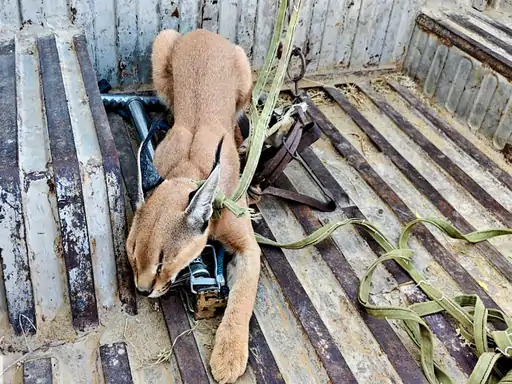
Counting caracals
On April 15, a workshop launching Project Caracal which included representatives from the Wildlife Institute of India (WII), Salim Ali Centre for Ornithology and Natural History (SACON), Rajasthan Forest Department, and Tiger Watch was organised with a focus on caracal conservation.
The Additional Principal Chief Conservator of Forests and Chief Wildlife Warden K.C.A. Arun Prasad told Mongabay-India that a census of caracals will be conducted over the next 18 months in the Ranthambore and the Dholpur-Karauli landscape in four tiger reserves: Sawai Madhopur, Dholpur-Karauli, Ramgarh Vishdhari in Bundi, and the Mukundra landscape in Kota. Researchers will also study their habitat, behaviour, and threats to create a conservation policy within two years. A project and a Caracal Working Group will be established for a separate census in the Thar desert.
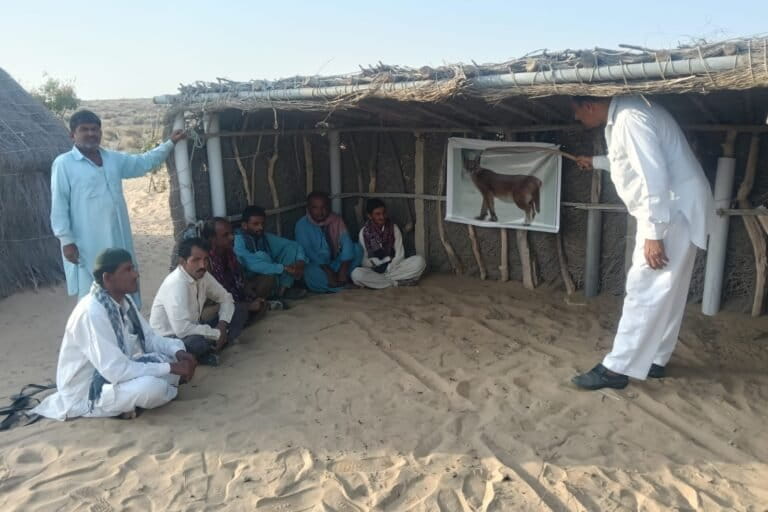
Meanwhile, Anoop Kumar, the Chief Conservator of Forests in Rajasthan, tells Mongabay-India, “After this incident (in March), the forest department is visiting every settlement, showing photos of caracals to educate village residents. We are telling them to inform the department immediately if they see such an animal like a cat, so we can rescue it. Those providing information will be rewarded.”
Awareness and compensation
Dharmendra Khandal, the executive director at Tiger Watch, a conservation biologist and co-author of the book Caracal: An Intimate History of A Mysterious Cat shares, “In my book, there is a chapter Threats in India, which notes that between 2000 and 2020, in the Rann of Kutch region of Gujarat, five out of 19 recorded caracals were killed by pastoralists due to livestock attacks. Similar killings were recorded in Ranthambore. Three cases were roadkills.”
On caracal conservation efforts, Khandal says that the compensation given for livestock killed by wildlife takes too long to reach beneficiaries. “The forest department should simplify this process and increase the amount. People in the desert often mistake caracals for desert cats, so awareness is vital, and schools are the best place for this.”
Increased sightings in the desert have sparked a debate about accurate counting and protection. Chatar Singh Jam adds, “Over the last few decades, many development projects, especially solar plants, have come to the desert. The government acquires large amounts of land for this.” He adds, “Some feel the government is staying quiet about the caracal to avoid obstacles in land acquisition for large solar plants and development projects.”
Sumit Dookia, an associate professor and a wildlife biologist at Guru Gobind Singh Indraprastha University, Delhi, emphasises the need for speed regarding compensation and says, “A systematic procedure and a project for timely compensation are needed. This requires collaboration with the Border Security Force (BSF) as well, because the caracal habitats are very close to the international India-Pakistan border.”
Dookia adds, “To prevent conflict, a proper compensation process should start immediately. This will stop pastoralists from killing them, allowing their numbers to grow. The Shahgarh killing is a rare case in India, so everyone must work together to raise awareness.”
Banner image: A caracal in Ramgarh area of Jaisalmer district, Rajasthan. Image by Sumer Singh Bhati and Pankaj Bishnoi.
Credits