


- To reduce wasteful expenditure on tree plantation, a forest officer teamed up with an artificial intelligence company to develop a machine learning-powered chatbot.
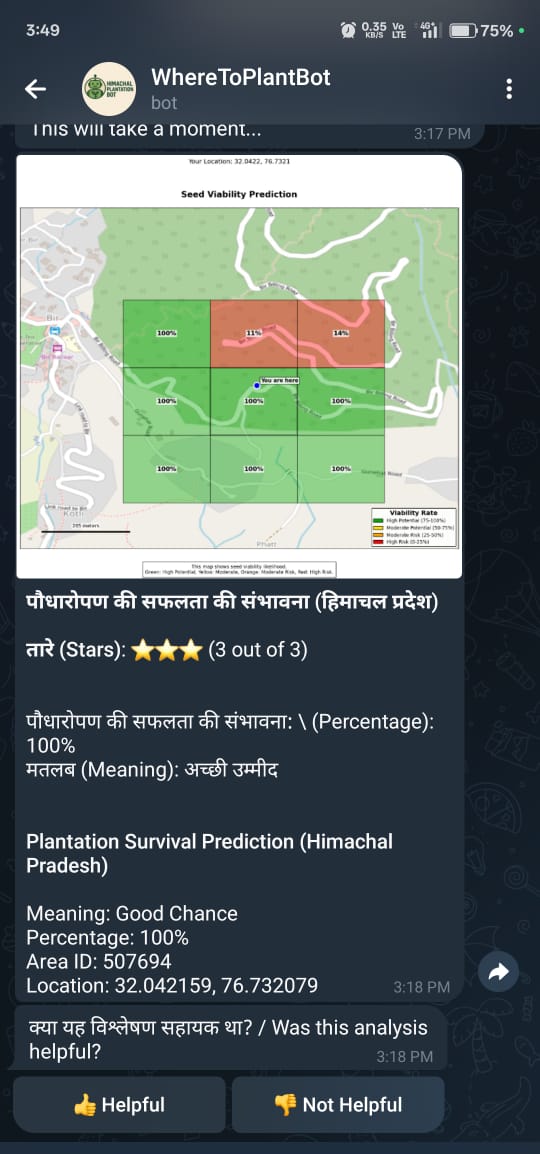
- Users share their location to receive a star rating signifying the site’s suitability for planting a particular species.
- While restoration practitioners welcome such tools, they caution that they are not yet perfect and will be improved with more data.
- They note that participatory governance is important for any tree plantation’s long term survival.
In 2022, Pushpendra Rana and his colleagues projected using a machine learning model that Himachal Pradesh would spend $100 million (approximately ₹95 crores) between 2020 and 2030 on planting trees that were unlikely to survive. They published the findings in the journal World Development.
But Rana, a serving Indian Forest Officer, didn’t just stop at drawing attention to the wasteful tree-planting practices in his state. Over the next four years, he focused on developing a restoration decision-support tool to aid in more successful tree planting in the country.
Rana partnered with RootIQ Labs Pvt. Ltd., a New Delhi-based artificial intelligence company, to develop WhereToPlant Bot, a chatbot that can predict the survival probability of saplings in a given location based on different climatic and environmental parameters.
This chatbot can be accessed by anyone with a Telegram account. Once they share their location pin, it uses machine-learning models to quickly respond with a survival probability score and a star rating for any and all plants for the particular planting site, ranging from ‘no chance’ to ‘high chance’.
The chatbot is currently exclusive to Himachal Pradesh, where it has been functional for over a year. The state forest department, mahila mandals (women collectives), yuvak mandals (youth groups) and self-help groups have taken its guidance to plant saplings, Rana told Mongabay-India. More than 200 women’s groups and 50 youth clubs used the tool in the field. DFOs and restoration practitioners as part of the Rajiv Gandhi Van Samvardhan Yojana (US$10.14 million community-driven plantation scheme in Himachal Pradesh) have also used the tool.
WhereToPlant has divided the Himachal Pradesh landscape into tiles of seven hectares each. The tool was used during the 2025 monsoon plantation season (July to September). District-wise information is still being compiled, according to Rana, but the available records show that the Himachal Pradesh forest department planted trees across approximately 3,000 hectares, with WhereToPlant guiding site selection for more than 500 hectares across over 250 plantation locations in Himachal Pradesh.

Knowing where to plant
India has set significant tree-planting targets for the upcoming decade. The country updated its nationally determined contribution (NDC) under the Paris Agreement to create a carbon sink of 3.5 to 4.0 billion tonnes of CO₂ equivalent through forest and tree cover by 2035. It also made a sizable pledge towards the Bonn Challenge to restore 26 million hectares of degraded and deforested land by 2030.
There is definitely an emphasis at the national and state level to mobilise funds for restoration, Rana said. “On paper, we are planting a lot,” the Shimla-based researcher added. “But the problem comes when the funds go to the lowest level, where the action actually happens.” There is no scientific criterion for identifying sites for restoration, according to Rana. “The Divisional Forest Officer (DFO) transfers money to the range officers, who then distribute it among the 10-12 beats under their belt. Once it reaches the beat officer, it is an ad-hoc decision, where to plant the saplings,” he said.
“Most of the time, these officers are transferred within three to four years, which means there is little emphasis on monitoring and evaluation,” Rana added.
WhereToPlant Bot enables ground workers to visit a site and swiftly make a science-based decision about whether it is suitable for planting saplings, Rana said.
“The bot provides interpretable guidance in the form of a score that communicates survival probability,” he said. “It doesn‘t claim certainty. But allows its users, be it frontline staff or local community members, to take actionable decisions,” he added. The tool has 87% accuracy, according to Rana.
However, behind this simple survival probability score, which ranges from 0 to 100, is a “committee of machine-learning models” that sifts through large datasets to produce these estimates, Rana said.
The tool has carved up the Himachal Pradesh landscape into 7,95,000 seven-hectare tiles. For each tile, an ensemble machine-learning model, including Random Forest, Gradient Boosting, and five other models, estimate the likelihood that a sapling planted there will grow into a tree. “These estimates are based on 300+ environmental and landscape parameters (including soil composition, elevation, climate patterns, and historical vegetation data) sourced from publicly available data,” Rana said.
A WhatsApp group collates feedback, where WhereToPlant users reshare the bot’s analsyis, including location details, along with photographs of the site. They also note whether they agree or disagree with the bot’s analysis, which is used to improve prediction accuracy. “Like other AI tools, this data is then reinvested to improve the model,” Rana said.
The choice of Telegram for the chatbot divided opinion among restoration practitioners Mongabay-India spoke to. Responses ranged from “Why do I need a Telegram account to use the tool?” to labelling it as smart “as it opens up access to all audiences with a Telegram account.” Rana explained that the tool is not hosted on Telegram. “[Telegram] is just a delivery channel. We chose it over WhatsApp, which demands pre-approved templates for sent messages,” he said. “Meta (parent company of WhatsApp) also charges for outbound messages,” he added.
Deciding what to plant
Debojyoti Chakraborty, a senior scientist at the Austrian Research Centre for Forests who has worked on similar tools at a pan-European scale, praised the execution and ease of use of WhereToPlant Bot. Chakraborty also highlighted some of its practical limitations. “A decision based only on survival is not so useful,” he said. Survival prediction without species-level guidance makes it difficult to take practical decisions, he told Mongabay-India over email.
“One of our learnings from the last year is that guidance on what to plant is as important as where to plant,” Rana said. He shared that the team has been hard at work and is hopeful of releasing a beta version of a species recommendation feature before the end of the year.
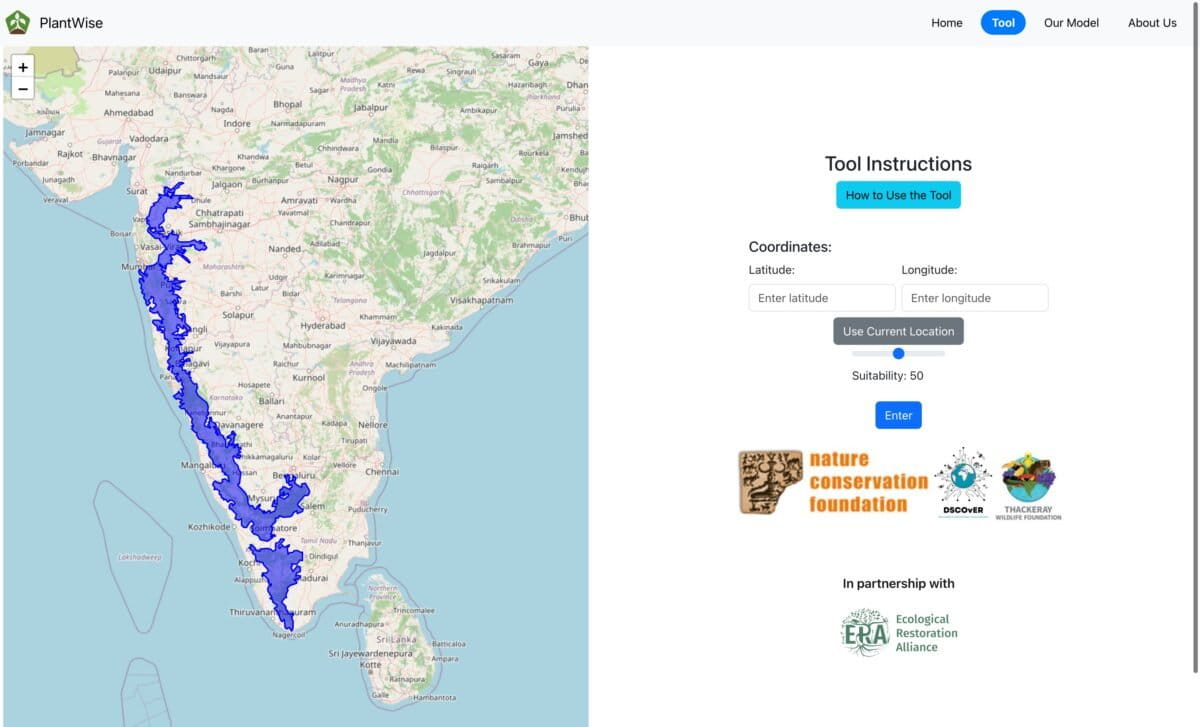
That said, there are other online decision-support tools for restoration that serve this exact purpose. Launched in July last year, Plantwise is a tool designed to assist restoration practitioners in selecting the most appropriate species to plant in the Western Ghats. It has been developed by researchers from the Nature Conservation Foundation (NCF), Thackeray Wildlife Foundation (TWF), and BITS Pilani, Hyderabad, in partnership with the Ecological Restoration Alliance-India.
Diversity for Restoration (D4R) is another example, originally developed for tropical dry forests in Colombia, it now covers tropical forests in select regions of South America, Africa and Asia. Developed by Alliance Bioversity-CIAT, its operations in India are restricted to the Western Ghats and led by the Ashoka Trust for Research in Ecology and Environment (ATREE).
Users can access both these tools via their websites, where they can enter the latitude and longitude coordinates of their restoration site to receive a list of species to plant.
“[Plantwise] employs species distribution models (SDMs) to predict the suitability of a plant species for a given location in the Western Ghats,” said Navendu Page, a scientist at the Thackeray Wildlife Foundation who led the data collection for the project.
To build an SDM, you require species occurrence data, aka the geographic locations of a particular species in that region. Field botanists spent days performing plot-based sampling to record this data. “Once you know more of these locations, you can build a species distribution model, which you then do for all the species in the region,” he said. The Plantwise team used 14,067 locations of 368 species to train its SDMs.
“Thankfully, there are field botanists like Navendu going out there, collecting data, and making it publicly available,” said Rohit Naniwadekar, a conservation scientist at the Nature Conservation Foundation and Plantwise programme lead. “They are generous enough to share their hard work, which makes it possible to build these models,” he added.
D4R sources its occurrence data from online databases such as GBIF, local researchers and herbaria, said Milind Bunyan, an ecologist at ATREE who heads its India project.
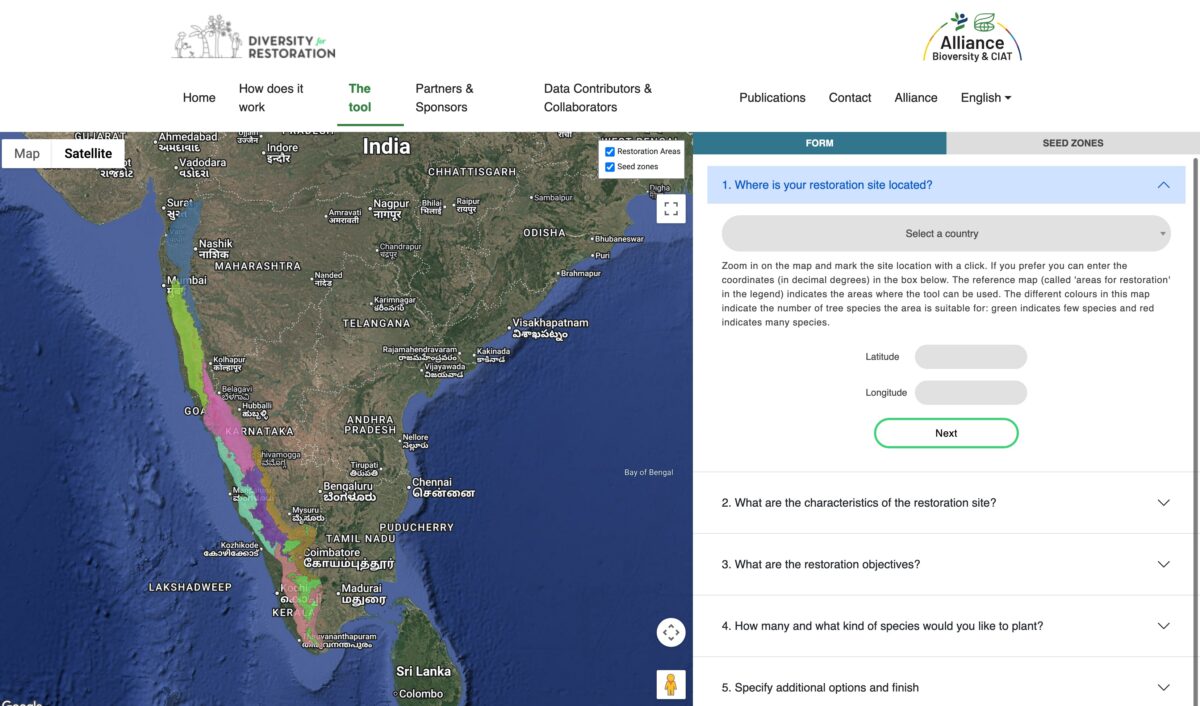
Unlike the WhereToPlant Bot, Plantwise and D4R are not powered by machine learning and employ algorithm-based models that rely on human-written rules. These models analyse species occurrence data along with environmental variables such as precipitation, temperature, and soil type of a given location to predict species survival, said Tobias Fremout, a researcher at Alliance Bioversity International-CIAT and co-creator D4R.
All these tools source their bioclimatic and environmental data from WorldClim, SoilGrids and other publicly available datasets maintained by different institutes.
D4R also takes into account the user’s tree-planting objectives. “For example, both Artocarpus heterophyllus (jackfruit) and Spondias pinnata (hog plum) can be planted next to irrigated lands in the Western Ghats, but the latter is more likely to attract bats that promote pollination,” Bunyan said. “Here, user-specified restoration objectives will determine D4R’s recommendations.”
D4R’s models also account for climate change when making predictions. It even provides recommendations on where to source seeds. “This comprehensiveness is something most tools don’t have,” Fermout said.
Integrating their model with local nurseries is the next step for Plantwise, said Naniwadekar. “Our goal is for people to start thinking of diversity, instead of going to a nursery and being anchored to what species are available there,” he added.
While D4R has incorporated traditional ecological knowledge into its model in other regions, in India, it is still a work in progress. WhereToPlant Bot also aims to include traditional ecological knowledge into its model. “When the local communities use the application, they should be able to share their feedback based on their local knowledge,” Rana said.
Read more: Why India’s tree-planting programmes are falling short

Long way to go
Tools such as WhereToPlant Bot, Plantwise and D4R are “a step in the right direction” but remain aspirational, Naniwadekar noted. “One day we will have enough data, and the models will be so perfect that we will be able to predict bioclimatically suitable species down to every one square kilometre,” he said.
Rana noted that as more field data become available, the system will continue to improve through adaptive learning. “At a broader scale, such tools can support climate resilience, biodiversity conservation, watershed protection, and evidence-based planning for forest restoration across Himachal Pradesh,” he expanded.
But scaling up will require solving systemic issues, he noted. “For better adoption, we need to strengthen community participation and maximise staff use through better supervision. AI can assist, but it cannot replace good governance,” he added.
Elaborating, he said, “Long-term plantation success depends on community participation, local decision-making, grazing and fire protection, maintenance, and monitoring after planting.” WhereToPlant provides scientifically informed recommendations, while local communities and the forest department contribute field knowledge and stewardship. “Combining ecological science with participatory governance can improve both plantation survival and long-term ecosystem restoration,” he concluded.
Banner image: Saplings being carried for plantation. Image by Pushpendra Rana.
Credits


