



- A new study from Maharashtra found that while tigers, leopards, and dholes share the same forests, they use landscapes in very different ways.
- Dholes are the most at risk among the three carnivores. Highly sensitive to fragmentation, they face severe isolation without continuous forest, whereas leopards dispersed even in fragmented areas.
- The study points to the need for targeted connectivity models that prioritise the habitat needs of the most vulnerable species.
Large carnivores range widely, reproduce slowly, and are highly vulnerable to human disturbance. When forests are broken up by farms, roads, industries, or settlements, populations may survive locally but lose the ability to exchange genes with their neighbours. Over time, this isolation leads to inbreeding, reduced genetic diversity, and a higher risk of extinction. Maintaining “connectivity”, the natural pathways that allow animals to move between habitats, is therefore critical.
At the same time, a new study shows that large carnivores don’t all respond the same way to fragmented landscapes. “Conservation planning in India has been centred on tigers, with corridors and mitigation measures largely designed around their ecology and movement patterns. While this has yielded important gains, it overlooks the fact that other sympatric species (species that live in the same geographic area), such as leopards and dholes, have very different ecological requirements,” says Shrushti Modi, a scientist at the Department of Animal Ecology and Conservation Biology at Wildlife Institute of India, and co-author of the study.
At the centre
The study was carried out in six protected areas of Maharashtra: Melghat Tiger Reserve, Navegaon-Nagzira Tiger Reserve, Pench Tiger Reserve, Sahyadri Tiger Reserve, Tadoba-Andhari Tiger Reserve, and Umred-Karhandla Wildlife Sanctuary. Except for Sahyadri Tiger Reserve in the Western Ghats, the other sites are located in the Vidarbha landscape.
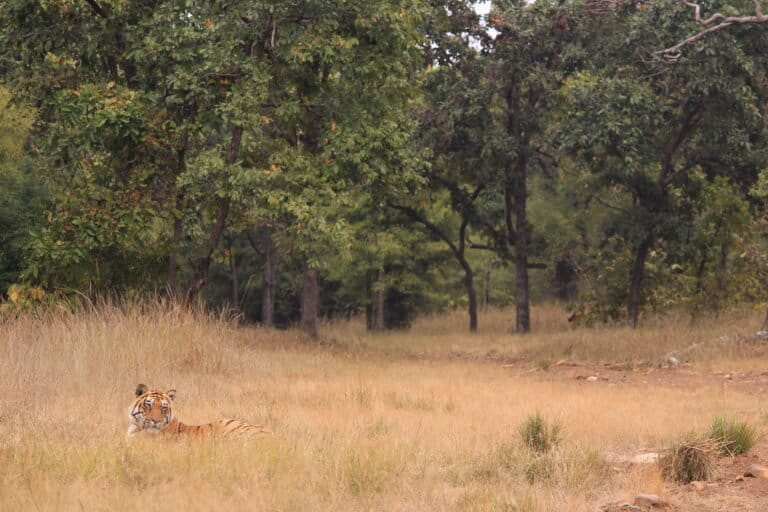
“Maharashtra is home to the fourth-largest tiger population in India despite having the second-highest human density. This contrasting high biodiversity and intense human pressure creates a unique setting for understanding how fragmentation affects wildlife,” says Modi.
What also made the state particularly significant, according to the researcher, is that its tiger reserves support three large carnivores living side by side: tigers, leopards and dholes. Studying them together offered a rare chance to compare how each species navigates a shared but fragmented landscape.
How the research was done
Between January 2016 and April 2019, researchers walked through forest trails and roads to collect 1,156 scat samples (droppings) of tigers, leopards and dholes. Fresh samples were collected and GPS coordinates were recorded along with associated information (scratch marks, habitat, surface the scat was on, and paw prints). The samples were later analysed in the lab. Using DNA extraction and microsatellite markers, the team could identify individual animals and measure genetic diversity.
From these samples, they identified a unique genotype dataset of 200 tigers, 95 leopards and 305 dholes. Advanced genetic and modelling tools were then applied to detect population structure and map differences across the landscape. Key variables considered included land use, vegetation cover, distance from roads and railways, livestock density, climate factors such as evapotranspiration, and human population density.
According to Modi, the greatest challenge was the scale of the study. “Covering multiple reserves and wildlife sanctuaries meant logistical complexity in sample collection and transfer. Personally, conducting fieldwork across all reserves was both demanding and deeply rewarding, and the collaborative support from the forest department and local staff was extremely helpful in overcoming these challenges,” she says.

What the study found
Leopards showed the lowest genetic differentiation across the landscape. Connectivity maps revealed a web-like movement pattern, with multiple alternate routes. Even in fragmented areas, leopards managed to disperse, reflecting their ability to live close to humans and in varied habitats.
Yet, this resilience had its limits. “Even this species showed signs of genetic differentiation among the Sahyadri Tiger Reserve population and other populations of the Vidarbha tiger reserves, a finding that highlights the subtle but real impacts of fragmentation even on generalist carnivores,” says Modi.
Tigers showed moderate connectivity. Their genetic structure was weakly differentiated, meaning populations were still exchanging genes but faced barriers. Dholes, in contrast, showed the highest genetic differentiation and the lowest migration rates. Their populations were split into several distinct clusters, with little gene flow between them.
Unlike leopards, dholes depend heavily on continuous forest, and their group-living behaviour makes dispersal harder. “Dholes are far more sensitive: their movements are constrained to a few narrow patches of contiguous forest. If these limited corridors are lost, it can risk populations to isolation, with serious implications for their long-term viability,” says Modi.
The study also uncovered an unexpected driver shaping movement: agriculture. Using evapotranspiration as an indicator, researchers found that agricultural expansion sharply reduced connectivity, especially for dholes. In contrast, for tigers and leopards, the main barrier was distance, populations further apart showed weaker genetic exchange. “This crucial finding highlights the importance of considering fine-scale land-use pressures when planning connectivity and conservation strategies,” says Modi.

Why this matters
The results showed that landscape connectivity is indeed species-specific. The findings also carry both a warning and a way forward. The warning: Maharashtra’s predators are already experiencing fragmentation, with dholes at a heavy risk. The opportunity: genetics and landscape models can guide conservationists in identifying and protecting priority corridors before it is too late.
The study points to the need for targeted connectivity models that prioritise the habitat needs of the most vulnerable species. “Corridor design and land-use planning must prioritise the most sensitive species. By addressing the needs of specialists like dholes, we can create a safety net that also supports more adaptable carnivores. In short, focusing on the most vulnerable builds a more inclusive and resilient framework for connectivity conservation in India’s rapidly changing landscapes,” says Modi.
Read more: Tracking tigers as they move from comfort zones to independence
Banner image: Even in fragmented areas, leopards managed to disperse, reflecting their ability to live close to humans and in varied habitats. Image by Shrushti Modi.
Credits


